


Exotic: Yoshikazu Ikeda White #3 Honyaki Gyuto 240mm with Fujinami Hamon, Amboyna Handle
Exotic: Yoshikazu Ikeda White #3 Honyaki Gyuto 240mm with Fujinami Hamon, Amboyna Handle 已缺貨,一旦有貨就會出貨。
庫存狀態
此商品無法配送。 只提供門市自取。
-
St Peters, NSW —2 Bishop St, Unit 2, St Peters NSW 2044
詳細規格
| 系列 | 池田美和 本燒 |
| 刀型 | 牛刀 / 主廚刀 |
| 刃型 | Double Bevel |
| 重量 | 203 g 7.16 oz |
| 刃長 | 230 mm .9.06 inch |
| 刃高 | 49 mm .1.93 inch |
| 刀背厚度(根部) | 3.5 mm 0.14 inch |
| 刀背厚度(中段) | 2.5 mm 0.1 inch |
| 刀背厚度(刀尖 1cm 處) | 0.8 mm 0.03 inch |
| 鋼材 | 白紙三號 | 碳鋼 |
| 刀身結構 | 本燒 |
| 廠方淬火硬度 | 60 HRC 以上 |
| 表面處理 | 鏡面拋光 |
| 刀柄 | 八角柄 花梨瘤 牛角 |
| 產地 | 堺 |
| 推薦用途 |
|

There is something particularly appealing about a Honyaki knife that doesn't rely on a full mirror polish to show off its hamon. This exceptional 240mm Gyuto, forged by the renowned Sakai blacksmith Yoshikazu Ikeda (池田美和), takes a more subtle and traditional approach. Featuring an elaborate Fujinami hamon and a special natural stone finish known as Oboro-ukashi (朧浮かし), executed by Nori Igarashi (五十嵐 宣), the blade displays a beautiful contrast between the soft, misty hamon and the clean Migaki finish of the surrounding steel. The result is a rather understated elegance that I find just as captivating as the highly reflective mirror-polished Honyaki knives.
The blade is forged from Shirogami #3 (White 3) carbon steel using traditional Honyaki construction. Unlike the more commonly encountered White 1 and White 2, White 3 contains a lower percentage of carbon, allowing it to achieve a somewhat more forgiving balance of hardness and toughness. Although it may not reach the extreme hardness or edge retention of its higher-carbon counterparts, White 3 is relatively approachable to sharpen and still capable of taking an exceptionally fine edge. In a Honyaki construction, where the blade is differentially hardened from a single piece of steel rather than laminated with softer cladding, this more forgiving character can be particularly desirable for a knife intended to see actual kitchen use.
What really sets this piece apart is the exceptional finishing work by Nori Igarashi (五十嵐 宣), a highly skilled Sakai sharpener. The blade features a Fujinami (富士波, Mount Fuji and Waves) hamon, with the distinctive mountain silhouette rising above the flowing waves along the blade. Rather than polishing the entire surface to a uniform mirror finish, Igarashi has carefully hand-finished the blade using natural Japanese whetstones, employing a technique known as Oboro-ukashi (朧浮かし). The term describes the soft, hazy appearance of the hamon, which seems to emerge or float from the surrounding steel. The natural stone polishing brings out the hardened structure in a delicate, misty white, contrasting beautifully with the smooth, reflective Migaki finish of the blade. Unlike the sharp, high-contrast appearance of a mirror-polished hamon, Oboro-ukashi creates a much softer and more atmospheric effect, allowing the Fujinami pattern to reveal itself gradually as light moves across the surface. It is a remarkably subtle finish, and one that requires considerable skill and patience to achieve consistently.
Being a 240mm Gyuto, this knife is also a practical and versatile kitchen tool, suitable for everything from vegetable preparation to slicing proteins. However, as with any Honyaki, it requires a level of care and sharpening experience beyond that of a conventional laminated Japanese knife. The reactive carbon steel needs to be cleaned and dried promptly, and the delicate natural stone finish deserves particular attention to preserve its original appearance. We have paired the blade with a beautiful Amboyna wood handle, whose rich colour and intricate grain provide a warm contrast to the restrained elegance of the blade, adding another layer of individuality to this already remarkable piece.
For me, the real attraction of this knife is how the skills of two exceptional craftsmen complement each other. Ikeda's forging and differential hardening create the foundation for the beautiful Fujinami hamon, while Igarashi's Oboro-ukashi polishing brings out its character in an entirely different way from conventional mirror finishing. The result is a knife that doesn't immediately overwhelm with brilliance, but instead rewards closer observation, with the misty hamon seemingly floating across the polished steel. Together with the distinctive Amboyna handle, this is a particularly interesting Honyaki for serious collectors and enthusiasts who appreciate the artistic possibilities of traditional Japanese knifemaking.
- 不要切硬物!日本刀比較脆,砍骨頭是絕對不可以的!
- 使用後請以中性清潔劑清洗,並擦乾;
- 請不要用洗碗機清洗刀具,這會損傷木柄;
- 注意不要讓刀長時間放在熱源附近;
- 其實用鈍刀比用利刀危險得多!
- 日本廚刀最好定期使用磨刀石研磨。
- 若是碳鋼刀,長期存放前請上油防鏽。

-

刀型:牛刀
主廚刀
向左滑動查看更多 >>
-

鋼材:白紙三號
製造商:
材質特性:碳鋼
廠方淬火硬度:60 HRC 以上
<< 滑動查看更多 >>
-
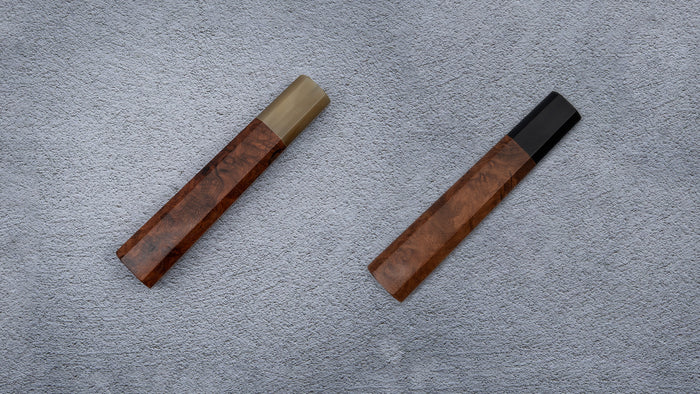
握柄規格
輪廓:八角柄
材質:
<< 滑動查看更多


您可能也喜歡
-
Yoshikazu Ikeda White 3 Honyaki Yanagiba 300mm with Wavy Hamon, Heart-shaped Ebony Handle售價 $42,633.00 正常價格 $50,155.00單價
-
Exotic: Yoshikazu Ikeda White 1 Mizu-Honyaki Sakimaru Takohiki 270mm, Fujinami Hamon Nenox Style Ebony Handle售價 $71,700.00 正常價格 $84,353.00單價
-
珍稀款:池田美和 青紙一號 水本燒 柳刃 300mm / 盛箸套組 #1售價 $87,226.00 正常價格 $102,593.00單價
-
珍稀款:池田美和 青紙一號 水本燒 切付柳刃 300mm 附血槽 Pau Rosa 套組售價 $73,661.00 正常價格 $86,634.00單價
-
佐治武士 VG-10 黑染黑色大馬士革 牛刀 210mm 黑檀木柄 牛角口金售價 $9,119.00 正常價格 $10,715.00單價
-
佐治武士 SG2 鑽石大馬士革 牛刀 240mm 黑檀木柄售價 $16,483.00 正常價格 $19,378.00單價
-
佐治武士 SG2 鑽石大馬士革 牛刀 270mm 黑檀木柄 牛角口金售價 $18,216.00 正常價格 $21,430.00單價
-
藤次郎 VG-10 Supreme 37層流霞 牛刀 260mm FD-915售價 $3,830.00 正常價格 $5,471.00單價
