
The Best Cutting Board for Japanese Knives
1Why a Japanese knife needs a soft board
A Japanese kitchen knife is usually harder, and ground thinner at the edge, than a European one. That is why it cuts so cleanly, and it is also why it suffers on a hard surface. Glass, stone, ceramic and steel boards are the worst of the lot: every cut drives the edge into something harder than the steel can forgive. Our first Japanese knife guide names them as the way thin, hard edges die.
Ordinary hard plastic is the quieter problem. Hasegawa, the Japanese maker whose boards we carry, says a delicate Japanese edge loses its sharpness quickly on a hard board, and its soft board is made to cushion and absorb each blow of the knife instead.
2Rubber, polyethylene or wood?
Three surfaces suit a Japanese knife. The right one depends on how you cook.
Soft rubber is the kindest to an edge. It gives under the blade and grips the food, and Hasegawa recommends it for delicate work such as sushi and sashimi. The trade-off is that a soft surface marks and stains more readily than a firmer one, so it wants washing soon after use.
Soft polyethylene is firmer than the rubber. It resists staining and deep gouges better than Hasegawa's rubber boards, so it suits cooks who cut a lot of meat or anything that colours a board.
Wood is fine too, especially end grain. We do not carry wooden boards at the moment. If you own one, keep it dry and oil it now and then: the food-grade mineral oil we use on our own handles and boards does the job, A$11.95.
3What makes a Hasegawa cutting board different
Hasegawa began as a maker of ski materials, and its boards borrow a ski's construction: a light wooden core sealed inside plastic. The core keeps the board rigid, which lets Hasegawa use a far softer surface than a solid plastic board could carry. It also makes the board 30 to 50 per cent lighter than a solid plastic one, by the maker's own figures, and Hasegawa's point is that a board you can lift easily is a board that gets washed.
The surfaces are made to be antibacterial, and the boards carry Japan's SIAA antibacterial mark. That is no substitute for washing the board after use.
4Which Hasegawa board to buy

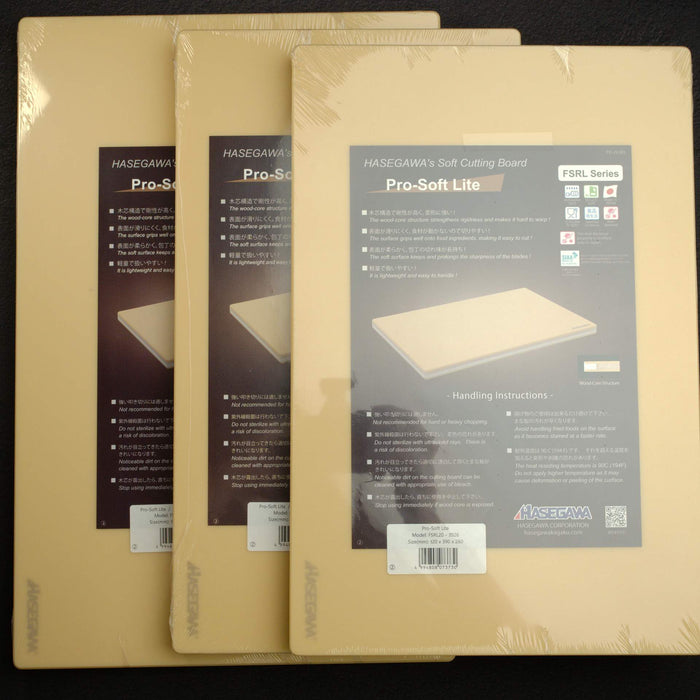
All of these were in stock when we checked on 5 November 2026, at the regular prices shown. Stock and sizes move, so check the product page before you order. Boards ship within Australia only. The whole range is on our cutting boards and mats page.
- Hasegawa Wood Core Pro-Soft Rubber Cutting Board: soft rubber over a wood core, the softest surface in the range and the pick for most kitchens. In stock from A$179.95 for 46 x 26 cm; 50 x 30 cm is A$219.95 and 60 x 30 cm is A$299.95, with commercial sizes up to 120 x 45 cm.
- Hasegawa Wood Core Pro-Soft Lite Rubber Cutting Board: the home-size version of the same wood-core rubber board, A$139.95 for 41 x 23 cm and A$179.95 for 44 x 29 cm; the 39 x 26 cm was sold out when we checked. A good fit for a small bench, or a kitchen that runs on a petty and a santoku.
- Hasegawa Pro-PE Lite Black Anti-Bacterial Cutting Board, Wood Core: soft polyethylene over a wood core, firmer than the rubber and better at resisting stains, from A$129.95 for 34 x 23 cm. The black surface makes light ingredients stand out.
- Hasegawa Pro-PE Wood-core Cutting Board Black, Commercial Size: the same firmer polyethylene in bench sizes, from A$189.95 for 50 x 30 cm, heat resistant to 90°C.
- Hasegawa Anti-Bacterial Round Cutting Board FKM Series: a light, thin round board in soft elastomer, 34 x 26 cm, 8 mm thick and about 560 g, A$69.95. It has no wood core, so it is a second board for small jobs rather than your main one.
Two small additions are worth having. The Hasegawa Anti-Bacterial Non-slip Mat, from A$29.95 (in the Black 25 x 12), keeps a board from sliding on the bench even when wet. The Hasegawa Anti-Bacterial Soft Cutting Mat, from A$59.95 (in the 39 x 26 cm; the 34 x 23 cm was sold out when we checked), is a soft sheet you can lay over a board you already own.
5What size board for a 210 or 240 mm gyuto?
Let the knife decide. A 210 mm gyuto needs room for the blade to travel and for your knuckles to clear the edge of the board, so for that knife the 46 x 26 or 50 x 30 cm Pro-Soft is the size to start on. For a 240 mm gyuto, the rule on our 210 vs 240 page is a board with about 45 cm or more of usable length, and 60 x 30 cm is the comfortable size. If you mostly use a santoku or a petty in a small kitchen, the 41 x 23 cm Pro-Soft Lite is enough.
6How to look after a rubber cutting board
- Wash the board soon after use, before stains have time to set.
- Hasegawa allows bleach on these boards. Do not leave a board soaking in it, and rinse it well afterwards.
- Hot water is fine on the wood-core rubber boards, up to 80°C on the maker's catalogue figures, but never boil one. The round FKM board should stay below 70°C.
- Use both sides of the thin round board evenly, so it stays flat.
- When the surface yellows or roughens, the Hasegawa Cutting Board Scrubber, A$18.95, takes off stains, yellowing and the fine grooves knives leave behind.
For the knife itself, our care page has the rest.
7Questions people actually ask
What is the best cutting board for Japanese knives?
A soft one. A wood-core rubber board such as Hasegawa's Pro-Soft is the kindest to a thin, hard Japanese edge and stays flat; soft polyethylene is a firmer choice that resists stains better. End-grain wood is fine. Never use glass, stone, ceramic or steel.
Are rubber cutting boards good for Japanese knives?
Yes. Soft rubber cushions each cut instead of jarring the edge, and Hasegawa recommends its soft board for sushi and sashimi. It marks and stains more readily than polyethylene, so wash it soon after use and refresh it with a board scrubber when it yellows.
How do you wash a Hasegawa cutting board?
Wash it soon after use, and oxygen or chlorine bleach is allowed by the maker; do not leave a board soaking in bleach, and rinse well afterwards. Hot water is fine on the wood-core rubber boards, up to 80°C on the maker's catalogue figures, but do not boil them, and the round FKM board should stay below 70°C.
What size board do you need for a 210 mm gyuto?
A 210 needs room for the blade to travel and for your knuckles to clear the edge of the board, so the 46 x 26 or 50 x 30 cm Pro-Soft is the size to start on. For a 240 mm gyuto, look for about 45 cm or more of usable length; 60 x 30 cm is comfortable.
Is a wooden board OK for a Japanese knife?
Yes, especially end grain. Keep it dry and oil it now and then with a food-grade mineral oil. We carry rubber and polyethylene boards rather than wood at the moment.
If you would rather ask before you buy, our stores in St Peters and Crows Nest (Sydney), Braddon (Canberra) and Prahran (Melbourne) are glad to help.