
210 mm vs 240 mm Gyuto: Which Size Should You Actually Get?
This is a fit decision, not a performance one, though it is almost always asked as though one answer were more serious.
1Measure two things, not your ambition
The most expensive mistake here is buying a 240 for the idea of it and then fighting it on a small board for a year.
Your board's usable length. Not its overall length. The usable part is what is left once you allow for the food sitting on it and the hand steadying it. A 240 mm blade wants roughly 45 cm to work through a stroke without the tip or heel hanging off. Plenty of home boards are 35 to 40 cm, and on those a 240 spends its life being manoeuvred rather than used.
Your hand. Palm width and finger length decide how much blade you can control in a pinch grip, and no threshold is worth printing because hands vary more than boards do. The practical test: hold a knife you own, take your normal grip, and notice whether you are steering the tip or being led by it.
If the two disagree, the board wins. You can adapt your grip. You cannot adapt your bench.
2What 30 mm actually changes at the board
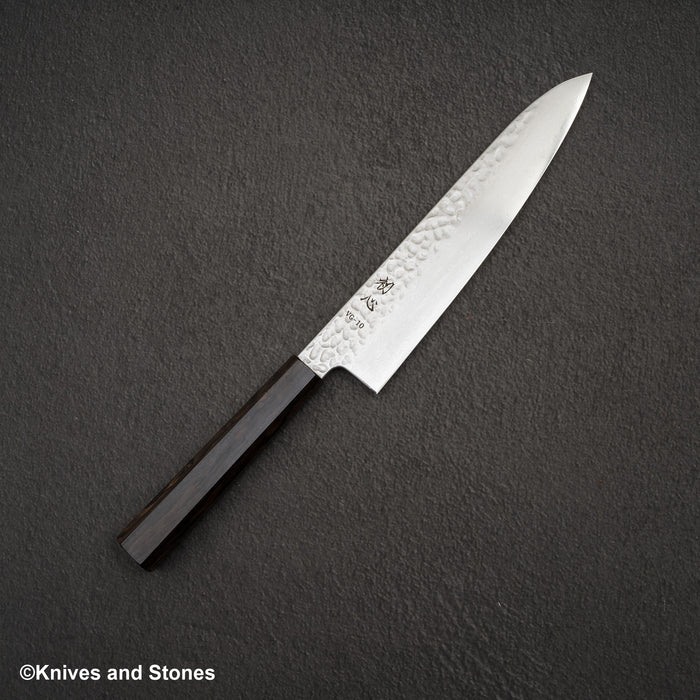
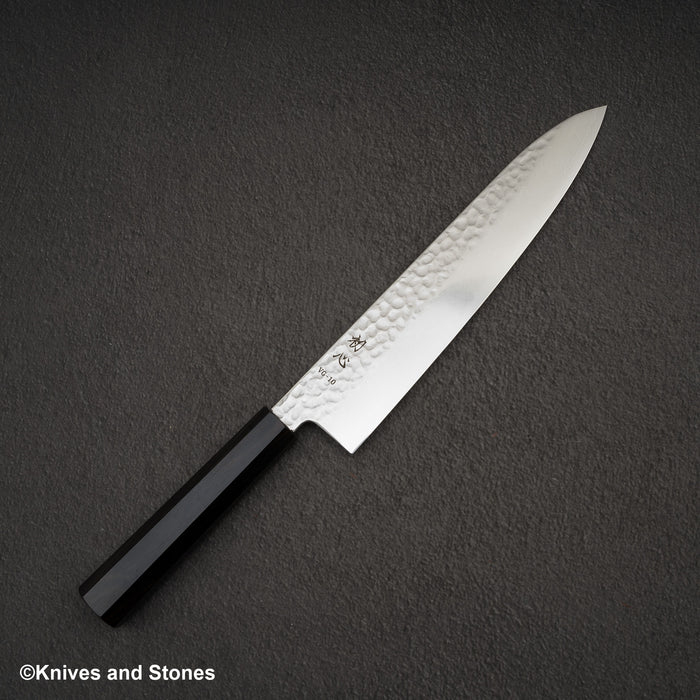
Knuckle clearance. A longer blade is usually a taller blade at the heel, which lifts your knuckles further above the board. On a full-height 240 you can chop through a pile of onion without clipping your fingers.
Strokes per cut. A 240 clears a large sweet potato or a wide cabbage in fewer pulls, which compounds across an evening of bulk prep in a way a spec sheet cannot show you.
Where the tip lands. On a 210 the tip sits closer to your working hand and is easier to place precisely, which suits shallots, garlic and herbs. On a 240 it sits further out, so long slicing through a roast or a side of fish gets easier and fine tip work gets slightly less immediate.
All three are geometry. None of them is sharpness.
3The 210: the default, and not a compromise
A 210 mm gyuto answers the question for most kitchens. It is nimble, it fits a standard board, it handles tip work comfortably, and it does not ask you to reorganise your bench. The trade-off is less blade in contact with the food and less knuckle clearance than a tall 240. If you routinely break down pumpkins or cook for eight, you will feel that.
Choose the 210 if: this is your first Japanese knife, your board is under about 45 cm, your kitchen is small, you are stepping across from a shorter European knife, or the length simply makes you nervous. That last reason is real. A knife you use tentatively cuts worse than a shorter knife you use confidently.
4The 240: more knife, and it needs the room
A 240 mm gyuto is the settle-point for a lot of people who cook seriously at home, and close to standard in professional kitchens. More blade, more height, more clearance. The trade-off is that it asks for conditions: the board, the bench space, and your comfort with a long blade near your other hand.
Choose the 240 if: your board is 45 cm or larger, you cook in volume, and you have used a 210-class knife enough to know you keep wishing for more blade. Those conditions matter together, not separately.
I will say the uncomfortable half out loud, because shops leave it out. The 240s are the ones I hear about later, at the back of a drawer, bought for a kitchen that turned out not to have room. I have never had that conversation about a 210. That does not make the 240 wrong. It makes it conditional, and the conditions are easy to check beforehand.
Past the two: 270 mm suits big hands and batch prep, but it is a different job rather than an upgrade. 180 mm is worth a look if a 210 feels long, as is a santoku.
5Five questions that decide it
- How long is the usable part of your board? Under 45 cm points to 210.
- What do you cut most? Volume vegetables lean 240; detailed prep leans 210.
- Is this your first Japanese knife? Then 210.
- What length do you use now, and do you wish it were longer? A specific yes is the strongest case for 240 there is.
- Does the longer blade make you tense? Believe that. Confidence cuts better than reach.
If you split the answers, take the 210.
6It is not the size that makes the knife
Thirty millimetres is a smaller decision than the two either side of it. The steel and the maker's heat treatment decide how keen the edge gets and how long it holds; the grind decides whether the blade falls through an onion or wedges it apart.
If you have not settled the steel question, start with VG-10 vs SG2. Then pick your length. Many of the lines we carry offer the same knife in both sizes, so you rarely have to trade the maker you want for the size you need. The gyuto hub shows both.
7Two to look at
Stock moves, so check the current product page before committing.
The default: Hatsukokoro Hayabusa VG10 Damascus Tsuchime Gyuto 210 mm, ebony handle, about $240
A VG10 stainless core at 59 to 61 HRC under stainless cladding, an octagonal ebony wa handle, and hammered tsuchime flats. I am not putting it here for the damascus, which sits in the soft outer cladding and does nothing for the cut. I am putting it here because the identical knife exists at 240 mm, which is the only way to answer this question honestly rather than by comparing two different makers and calling the difference length.


If you have the board for it: the same knife at 240 mm, about $280
Same steel, same grind, same handle. The extra forty dollars buys 30 mm more edge and a heel that stands 49 mm tall instead of 46 mm, which is exactly the knuckle clearance described above. Choosing between these two really is choosing between two numbers on a tape measure, which is the whole argument of this page.


Pairing both picks from one line is deliberate: it keeps this a size decision, not one tangled up with steel choice.
8Questions people actually ask
Is a 240 gyuto too big for home use?
Not inherently, but it depends on your board rather than your kitchen's square footage. A 240 wants roughly 45 cm of usable board length to work through a full stroke; below that it gets manoeuvred instead of used. If you have the board and you cook in volume, a 240 is a perfectly reasonable home knife. If you are unsure, the 210 is harder to regret.
Does a 240 gyuto cut better than a 210?
No. From the same maker in the same steel with the same grind, the two carry an identical edge. What changes is reach, blade height and knuckle clearance. A 240 clears large produce in fewer strokes and lifts your knuckles further from the board. A 210 places its tip more precisely on a small surface. Neither is sharper.
What size gyuto should I buy first?
210 mm. It suits the boards most home kitchens actually have and covers vegetables through proteins, while letting you build technique without fighting the tool. If you later keep wishing for more blade during bulk prep, a 240 becomes a well-informed second purchase.
Is a 210 gyuto big enough for a whole chicken or a large roast?
For a chicken, yes. That work is closer to precise cutting than long slicing. A 210 gets tight on single-stroke slicing through a wide roast or a large fish fillet, where a 240 or a dedicated slicer cuts cleaner in one pass. Neither length belongs on bones.
If you would rather hold both before deciding, our Sydney and Canberra showrooms keep 210s and 240s on the bench side by side. Bring the dimensions of your board. It settles this faster than anything I can write.
