
Kasumi vs Honyaki: What the Mist Line Tells You
1What kasumi is

The trade name for the construction is awase (合わせ, "joined"): a body of soft iron, the jigane (地金), with a hard steel, the hagane, forge-welded on as the cutting edge. On a single-bevel knife that means two layers: iron for the body, steel for the edge. The iron's job is to back the brittle steel. The edge chips less, the blade has some give, and the knife is cheaper than a honyaki.
The name comes from the look of the finished blade, not from the weld. Polished on a #1000 to #2000 stone, the hard steel takes a bright gloss while the soft iron stays hazy and un-mirrored. That haze is the mist the word names, and the same word serves for both the construction and the hazy finish grade. Our clad construction page shows the cross-section.
2Where the line sits
On a kasumi the boundary between steel and iron sits near the cutting edge, because that is where the weld sits. A honyaki's hamon sits mid-blade toward the spine, where the clay line lay. So a line near the edge on a knife in your hand is a construction line, the join of a clad knife, not a fire line. The honyaki itself, the clay and the quench, is on our honyaki vs monosteel page, and its geometry on the honyaki construction page.
3Hon-kasumi and the grades we stock
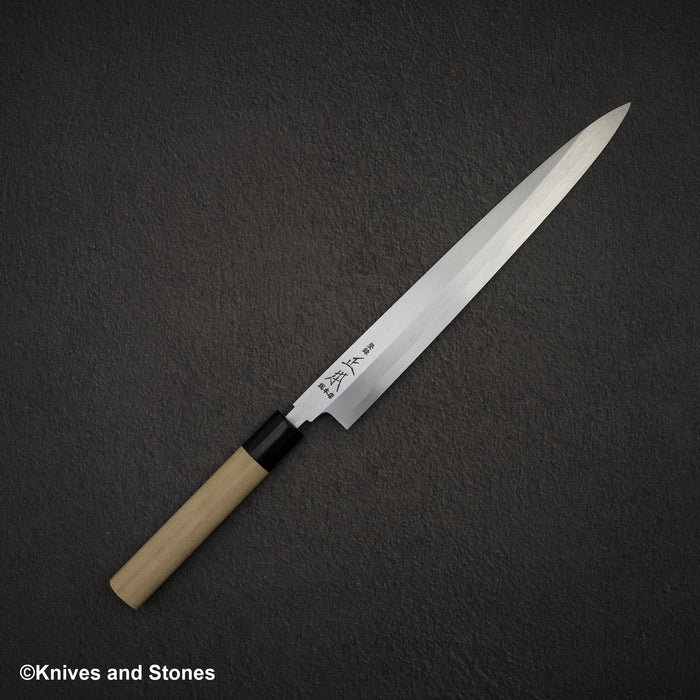
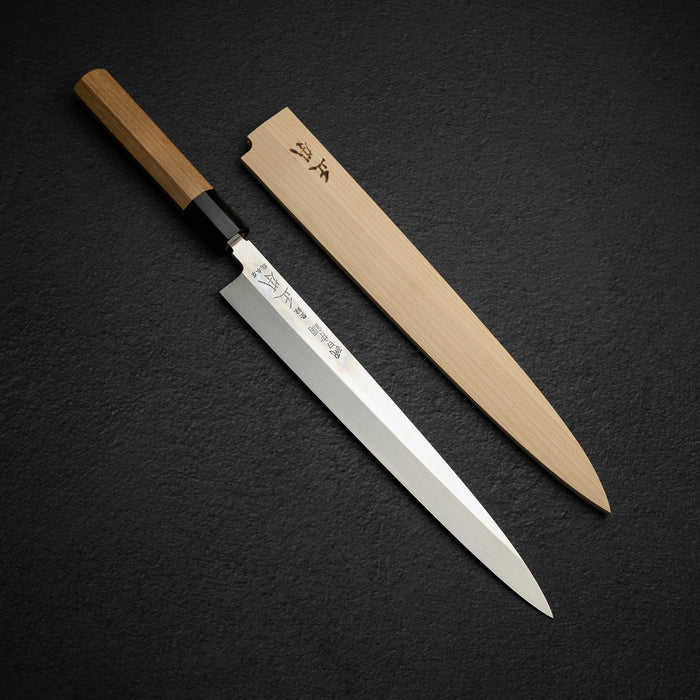
There is no industry standard for hon-kasumi (本霞, "true mist"). Depending on the maker it means a better steel, a finer hand finish, or both. One Tokyo maker uses it for a premium steel clad in soft iron; one Sakai house grades its lines by steel and polish together. The cheap tier goes by another name, kairyo-kasumi (改良霞, "improved kasumi").
The ladder we stock is Masamoto's, and it shows how the tiers stack: KK Kasumi in White 2 carbon, KS Hongasumi in the same White 2 at the hon-kasumi grade, KA Hongasumi in Blue 2, and above them the HS and HA honyaki.
4Hardness, sharpening and chipping
In our experience a honyaki runs about 1 to 2 HRC harder than a comparable knife that is not a honyaki. The reason sits in the quench: steel under clay cools more slowly, while the uncovered surface cools fastest and comes up slightly harder. Same steel, same maker, that is the size of the gap. It is not a law that pins every knife to a grade; it depends on the maker.
One maker publishes its targets, and they deserve a careful read: honyaki in White 1 at 64±0.5 HRC, hon-kasumi in White 2 or Blue 2 at 63±0.5. The steels differ, so those numbers do not isolate construction. Treat them as one maker's numbers, nothing more.
Sharpening is where the construction shows day to day. Most of the ground face of a kasumi is soft iron, so the stone cuts fast and the knife is quicker to sharpen. A honyaki's face is hard steel right out to the flats, so the same edge takes longer and more skill.
Chipping goes the other way. A honyaki is harder and more prone to chip, and misuse or a poor repair job can crack one in two. The iron in a kasumi makes it forgiving: a warped kasumi can be straightened with force, while a warped honyaki is very hard to correct.
5Care: the iron goes first
The soft iron of a kasumi reacts before the steel does, so you will see dark discolouration first, in a band above the edge line. Dark staining is surface-level; red rust is another thing and wants removing at once. If you are choosing a steel, the Blue steels resist discolouration better than the White ones. Our rust and patina care page covers what to do about it.
6The single-bevel back
Many of these knives, in either construction, are single-bevel, and that asks one sharpening habit. The back of the blade is hollow-ground, the urasuki, and the work is to keep a thin flat rim of land, the ura-oshi, about 1 to 1.5 mm wide, at the edge and at the spine. The sharpening falls on both faces: bevel side and back.
7Which one to buy
The makers classify it for you: honyaki for the advanced user, awase for the beginner and the intermediate. Professional kitchens often work daily with awase, the deba and the usuba, and keep a honyaki for sashimi work. One caution from the same makers: a honyaki is not for hard ingredients.
On price, a honyaki costs several times a kasumi; one maker's like-for-like list puts it close to 3x. If you sharpen your own knives and you want the sword-style craft under clay, a honyaki is your knife, and you accept the slow sharpening and the care it asks. If you want a forgiving working knife you can put on the stone in a few minutes, a kasumi is the one, and at a hon-kasumi grade it is a professional's knife, not a consolation prize.
8Two myths
Kasumi means cheap. It does not. Factory roll-bonded clad stock and a forge-welded awase are different things, and a hand-forged hon-kasumi is a professional knife; it is only cheaper than the honyaki beside it, not lesser.
Honyaki is always better. It is not. One of Japan's major makers says outright that not every honyaki beats every awase knife. The construction is a trade, not a ranking.
9Questions people actually ask
Is kasumi worse than honyaki?
No. Makers who make both class them by use and skill, not by rank. A honyaki carries a harder edge and a hamon, but a kasumi sharpens faster and takes more abuse, and professional kitchens run them daily and keep a honyaki for the work that asks for one.
Is a hon-kasumi a honyaki?
No. Hon-kasumi is a grade of kasumi, and depending on the maker it means a better steel, a finer finish, or both. It is still a welded knife, soft iron behind a hard steel edge, so its line sits near the cutting edge. A honyaki is one steel, and its line runs mid-blade toward the spine.
Why does my kasumi knife discolour above the edge?
That band above the weld line is the soft iron, and the iron reacts first. Dark discolouration is surface-level; if red rust appears, remove it at once. Blue steels discolour less readily than White steels.
Is a honyaki harder?
Usually, yes: in our experience about 1 to 2 HRC harder than a comparable knife that is not a honyaki, because the uncovered surface cools fastest in the quench and comes up slightly harder. One maker's targets, honyaki in White 1 near 64 HRC against hon-kasumi in White 2 or Blue 2 near 63, carry a steel difference in them, so they do not prove the gap on construction alone.
If you would rather hold both, come into our Crows Nest or Prahran shop: a kasumi line and a hamon read differently in the hand than in any photo.
