
How to Flatten a Whetstone
1Why stones dish, and why it matters

A stone wears as it cuts. The centre takes the most contact from the blade, so it wears first and wears fastest, and the surface slowly becomes a shallow bowl with a rim around it (that bowl is what sharpeners call a dished stone).
Sharpening on a dished stone quietly undoes your work. The bevel follows the hollow, so what should be a flat facet becomes slightly rounded, and the angle drifts partway through each stroke, which is exactly what you do not want when you are trying to hit one angle consistently. On a single-bevel knife the problem is sharper still: the flat back of the blade, the ura, has to stay flat, and only a flat stone can keep it that way.
Softer and coarser stones go out of flat faster. A coarse waterstone cuts aggressively and wears the same way, so it wants flattening often; a fine, hard stone moves much more slowly. Oil stones sit at the other end of the scale and rarely need flattening at all.
2How to check whether your stone is flat
Pencil and water are the whole toolkit. Draw a grid of pencil lines over the stone's surface with a normal pencil or a ballpoint (a marker is the wrong tool here, because its ink soaks into the stone and will not come off). Then rub the stone on a flat reference surface, or just flatten it.
When the stone comes back, read the grid. Where the pencil has disappeared, the surface is high, because it touched the reference and was ground away. Where pencil lines are still sitting, the surface is low, because it never made contact. The stone is flat again when the whole grid is gone, edge to edge. It takes about a minute and it is the honest answer to "is my stone still flat".
3Ways to flatten a stone, compared
| Method | Speed | Cost | Watch-out |
|---|---|---|---|
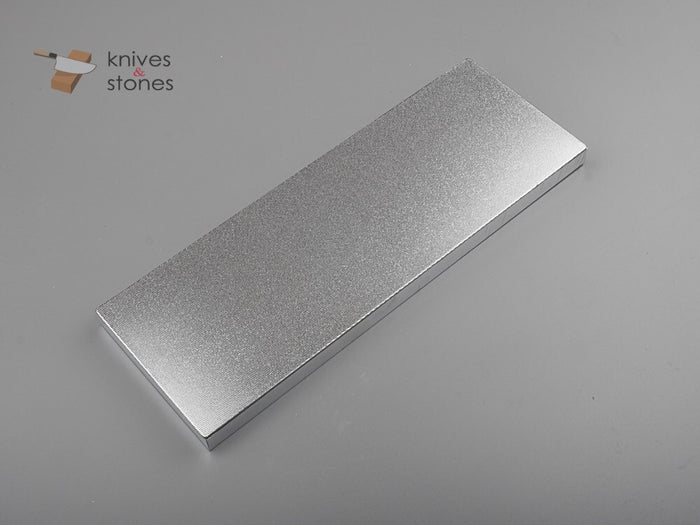
| Diamond plate | Fastest | Highest | Break-in: a new plate sheds loose diamonds at first |
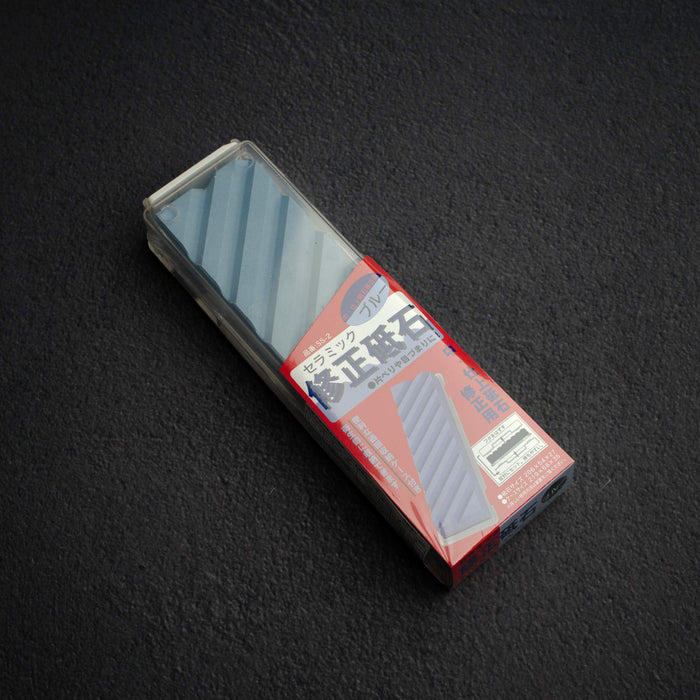
| Ceramic or silicon carbide flattening stone | Moderate | Low | Rub back and forth with water; slower than a plate |
| Wet/dry sandpaper on a flat surface | Moderate | Low | The result is only as flat as the surface under the paper |
| Rubbing two stones together | Slow | Free | Unreliable: a convex and a concave stone mate each other |
| Concrete or pavers | Unpredictable | Free | A stopgap only; not recommended |
The diamond plate is the fast way: it stays flat, and it works on nearly any stone. A dedicated ceramic or silicon carbide flattening stone is the traditional way and cheaper to buy; you wet it and rub the whetstone back and forth across it with water. Sandpaper works if, and only if, you lay it on something genuinely flat, because the paper carries every imperfection of what is underneath straight into your stone.
Rubbing two stones together is the old workshop trick, and it is unreliable. Two surfaces only flatten each other if one is already flat; otherwise a hollow stone and a crowned stone simply fit together like puzzle pieces and both stay curved. Three stones rotated in sequence does genuinely work, because three surfaces cannot all mate, but it is slow. And a scrap of concrete will get a hopeless stone workable in an emergency, though we would not make a habit of it.
One trade-off worth knowing before you buy: on very coarse stones, around #120 to #400, some Japanese stone sellers steer you toward a flattening stone instead of a diamond plate, because those big, hard grains can rip the diamonds out of a plate's surface. Other sharpeners run a coarse plate on coarse stones without trouble. Treat it as a trade-off rather than a rule; a plate you use gently on coarse stones will last longer.
4Step by step with a plate or flattening stone
- Wet both surfaces. The flattening stone or plate and the whetstone both want water.
- Draw the pencil grid on the whetstone, as above.
- Work the whetstone over the plate in long overlapping strokes, or figure-eights, with even, light to moderate pressure. Keep the whole stone face in play and let the plate overhang the stone's edges, so you are not tilting into the stone's rim.
- Do not chase the high spots. Rub the whole face evenly and the high spots come down on their own; grinding away at the visible dish is how stones end up wavy.
- Stop when the pencil grid is gone. Flat is flat; more grinding after that is just stone you are throwing away.
- Chamfer the stone's edges lightly once it is flat. A freshly flattened stone has sharp corners that can chip and nick a blade; a small bevel on the rim prevents that.
- Rinse both the stone and the plate thoroughly before you sharpen anything. The slurry from flattening is full of coarse grit, and carrying it onto your next stone is how a fine edge picks up deep scratches.
The same steps work with a ceramic flattening stone in place of the plate.
5How often should you flatten a stone?
Even the trade does not agree on this one. A stone maker's guidance says to check and correct the stone before every sharpening session. A specialist retailer's guidance is looser: every two to four knives for coarse and medium stones, every five to ten knives for fine stones above #3000.
Our position sits between them and is more practical than either: check the stone every session with the pencil grid, and flatten it when the grid shows a dish or when the feel of sharpening changes, the stone skating under the blade instead of biting. Caught early, flattening takes a minute or so. Left too long, a badly dished stone can take twenty or thirty minutes of grinding to bring back, and that is the real cost of waiting.
6Fine stones, natural stones and splash-and-go stones
Very fine stones want a gentler touch in flattening too. A coarse plate leaves deep scratches in a fine polishing stone, so finish the job with a finer plate or with a dressing stone (a nagura-style rubbing stone) to take the scratches back out. Natural stones are usually flattened with a fine diamond plate, around #400 to #600.
Splash-and-go stones deserve their own warning. Many modern resin-bonded or magnesia-bonded stones are designed to be used wet but never soaked, and a long soak softens them. Vitrified (fired, ceramic-bonded) stones tolerate soaking. Know which kind you own before you drop any stone in a bucket.
One more thing worth catching early: a crack. If your stone cracks, grind the crack away while it is small. Cracks run deeper as they grow, and a crack that reaches the edge of the stone is how stones break in half.
7What we use and sell
We sell Atoma diamond plates in 140, 400, 600 and 1200 grit, and the diamond sheet is replaceable, so the plate base outlives several sheets. A new plate sheds a few loose diamonds at first, so run it on a coarse or medium stone a few times before you trust it on a fine one. For the traditional route we stock the Suehiro ceramic flattening stone in coarse and medium, and the Imanishi Suiheikun fixing and flattening stone in an extra large size.
8Questions people actually ask
Can I flatten a whetstone with sandpaper?
Yes, with one condition: the surface under the paper must be truly flat. Wet/dry sandpaper on a flat reference surface works well, but paper laid over an uneven bench copies every bump and hollow into your stone. Use a coarse grit, keep it wet, and replace the paper as it loads up with stone.
Can I flatten a stone by rubbing two stones together?
Not reliably. Two curved surfaces simply mate: a hollow stone and a crowned stone will grind each other while both stay curved. Three stones rotated in turns does flatten them, because three surfaces cannot all fit each other, but it is slow work. A diamond plate or flattening stone does the job in a fraction of the time.
Do I need to flatten a brand new stone?
Check it first. A pencil grid takes a minute: if any lines survive a few light passes on a flat plate, flatten the stone once so you start from a surface you know is true.
Which grit of diamond plate should I buy for flattening?
A coarse one: 140 or 400 cuts flattening time down hard, and 140 is the usual pick for coarse and medium stones. If you also keep fine polishing or natural stones, a 600 makes a better finish on those, since a coarse plate leaves deep scratches in a fine stone. If you keep both coarse and fine stones, two plates cover both, coarse for the coarse stones and finer for the fine ones; we sell Atoma plates and replacement sheets in 140, 400, 600 and 1200 for exactly that.
If you would rather flatten a stone with someone walking you through it the first time, come into our Crows Nest or Prahran shop and we will show you on your own stone.
