
Handmade Japanese Knives: Forged by Blacksmiths We Know by Name
1What we mean by handmade

"Handmade" is a claim about hands, so we tie it to a name: forged by a blacksmith whose craftsman page we publish, with his name or his workshop's in the product title. That is a narrow test on purpose. It answers the one question the word should carry: who made this knife?
Machines are normal: the official Sakai forging steps use a power hammer and a grinder, with hand work and judgement at every stage, and the smith, the sharpener and the handle maker are often three different people. Our authentic Japanese knives page sets out what the labels, marks and patterns do and do not prove.
We do not stretch the label beyond the names on this page: for other lines the record does not always reach the bench, so we claim nothing, either way. What is here is what we can name.
2Sukenari, Toyama
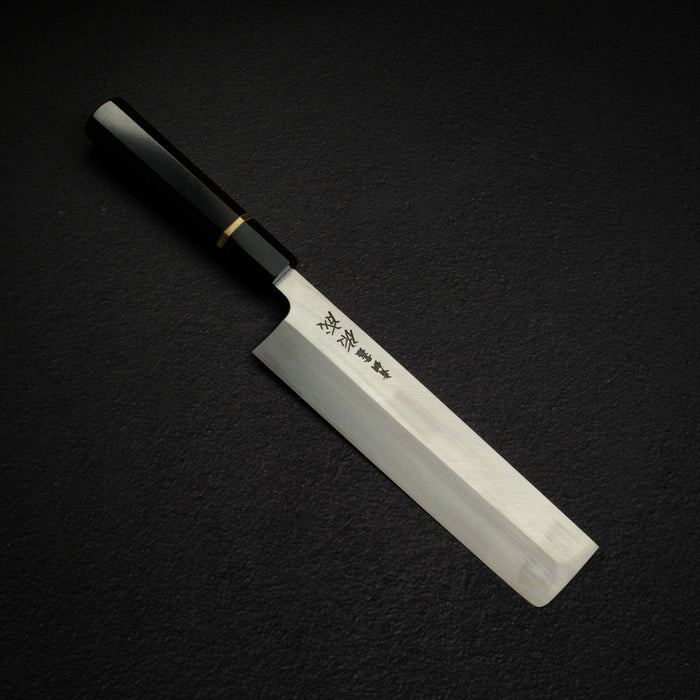
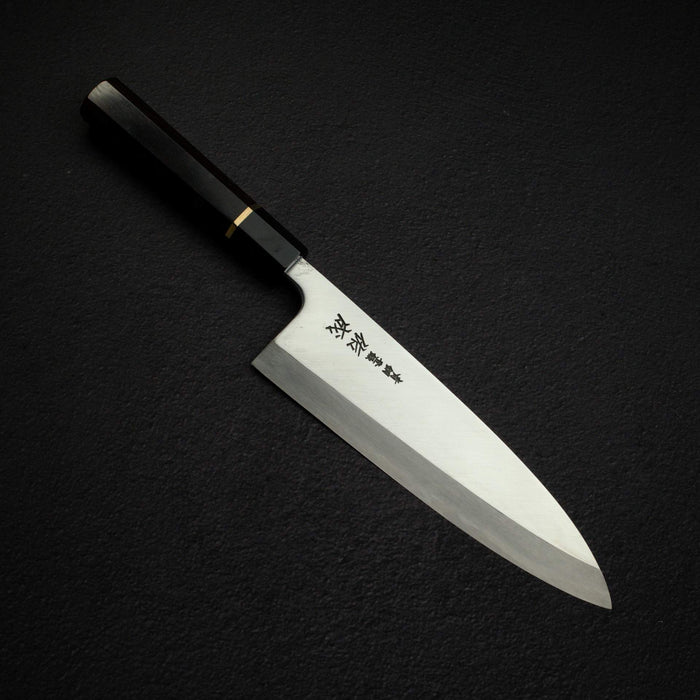
Nobuo Hanaki (花木信夫) is the public face of Sukenari, the knife maker of Fuchu, Toyama City, Toyama, which has made knives continuously since 1933, all of them in its own factory. James has dealt with Sukenari first-hand since 2016; on the first visit, in April that year, Hanaki hosted us at the forge, and a photograph from that visit shows a red-hot blade being hammered by hand on the anvil. The company's official disclosure lists him as the person who runs the operation. The pair we feature is the Sukenari Blue 2 Kanto usuba (a vegetable cleaver) and the matching Blue 2 deba (a fish knife), both at 210 mm. More on him: Nobuo Hanaki, and the knives on the Sukenari range.
3Satoshi Nakagawa, Sakai
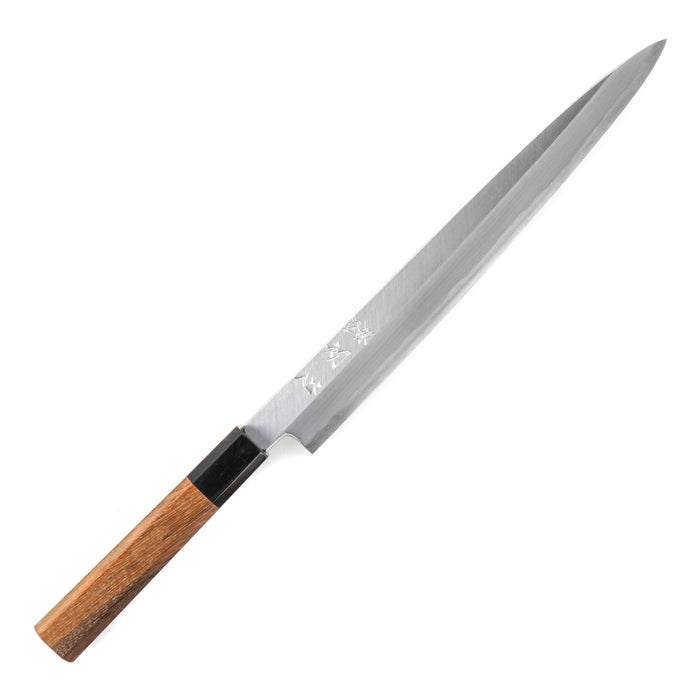
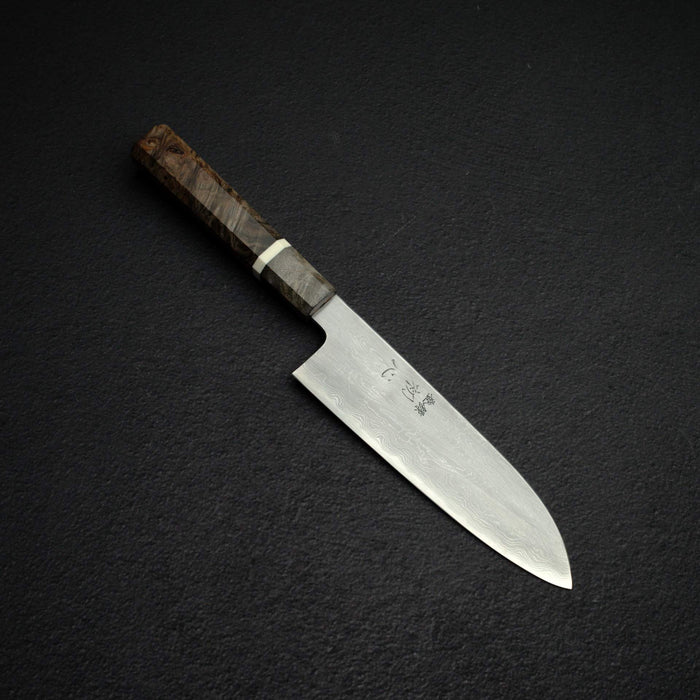
Satoshi Nakagawa (中川悟志) runs Nakagawa Uchihamono in Nishi-ku, Sakai, in Osaka, and the national programme has certified him a Traditional Craftsman (dentō kōgeishi) in the forging division; per the trade press, nobody in Sakai's history had been certified younger. He came to the forge the hard way: sixteen years under Kenichi Shiraki, whose retirement in 2020 passed the workshop, its machines and its future to him. The method is distinct enough for the trade press to name it: heated iron and steel go straight under the belt hammer and are forge-welded there, no hand-hammering first, in a forge he keeps at about 1,200 degrees and reads by eye. The range runs from White steel #3 through #1, Blue #2 and #1, to stainless Ginsan and VG10, the crown of it mizu-honyaki, water-quenched the old way; only a handful of smiths in Japan still make those, and his reverse-clove mizu-honyaki yanagiba (a long slicing knife) are limited to thirty a year. James has stood in front of that forge, and his fire also sits behind lines we sell under other names, because in Sakai the smith's name is often the last thing to reach the customer. See Satoshi Nakagawa and his knives.
4Yoshikazu Ikeda, Sakai
Yoshikazu Ikeda (池田美和) apprenticed to his father in 1967 and did not light his own forge, in Sakai, until 1983. His workshop, Ikeda Tanrenjo (池田鍛錬所), works under the mark Sakai Hokushin (堺北辰), and the national register certified him for Sakai forged cutlery in 1988. In Sakai the forge and the edge are separate trades held by separate people, so his name is the forging side of the knife. What we hold from him is his Blue 1 mizu-honyaki yanagiba sets. More: Yoshikazu Ikeda and his knives.
5Takeshi Saji and Yu Kurosaki, Echizen

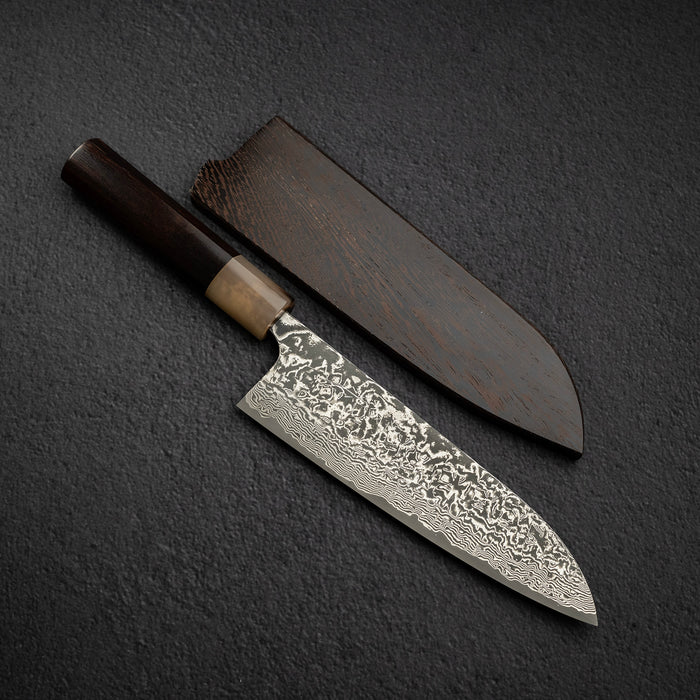
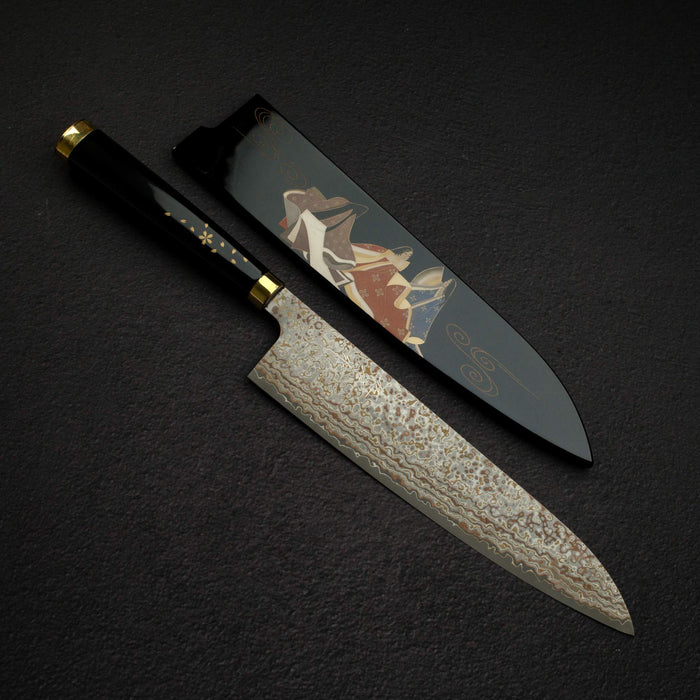
Takeshi Saji (佐治武士) is the third-generation master of Saji Uchihamono, the workshop founded in 1916 in Echizen, Fukui, certified a Traditional Craftsman in the Echizen forged cutlery division on 25 February 1994. He apprenticed under his father, the workshop's second generation, straight out of junior high school, and succeeded to the name in 1963; his son-in-law Kazuo Nomura runs the company today. On a visit to the workshop, Saji-san stood James at his air hammer and taught him to forge a knife: the hammer itself, under his direction, not a demonstration from across the room. The village links the two names in this heading: Yu Kurosaki (黒崎優) found the trade in a job listing at the public employment office and learned it in the shared workshop at Takefu Knife Village, where, as James has it, he trained under Hiroshi Kato and Takeshi Saji. Kurosaki is known for tsuchime (a hammered finish) brought up to a shine; a dimpled surface gives food less to cling to. The knife of his we hold is the Yu Kurosaki Raijin VG10W Bunka 165mm, a bunka (a compact kitchen knife with an angled tip). Pages for both: Takeshi Saji and Yu Kurosaki, with their knives on Saji and Kurosaki.
6Yoshihiro Yauji, Echizen
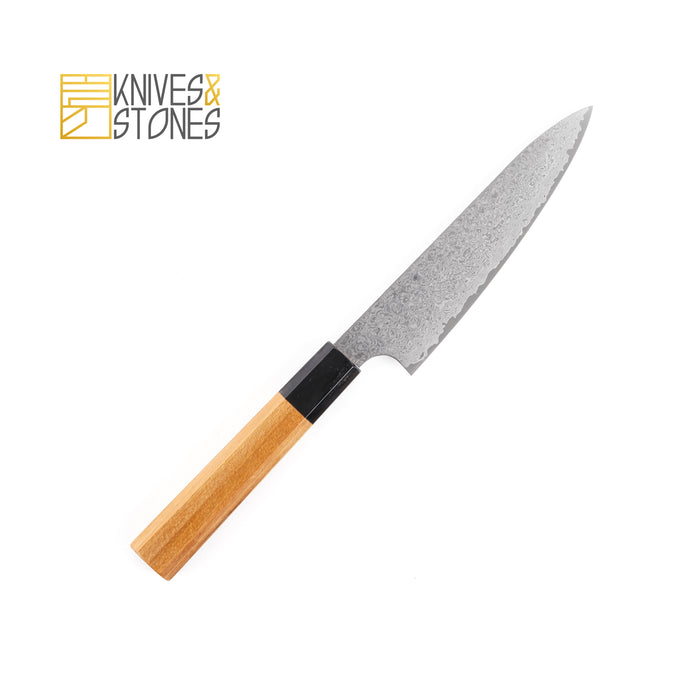
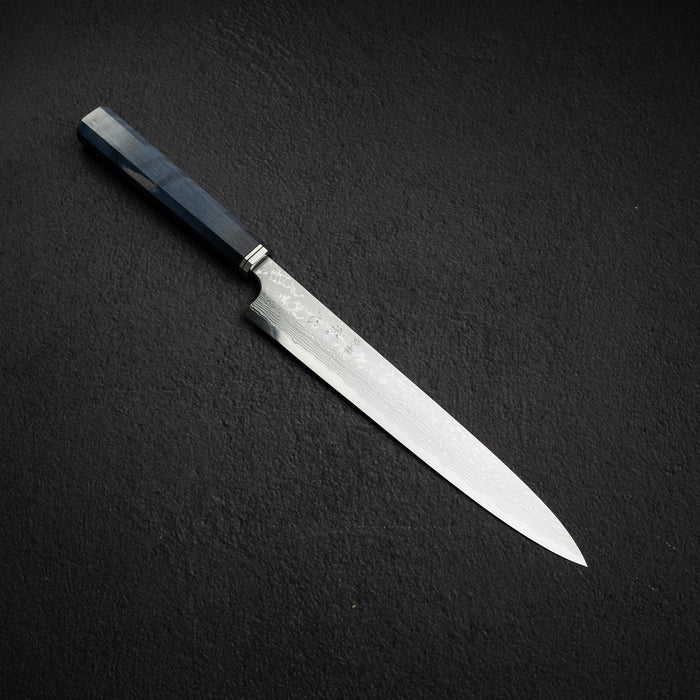
Yoshihiro Yauji trained under Hideo Kitaoka at Kitaoka Hamono, and went independent in Echizen in April 2021 under his own workshop name, 寬 (Kutsurogi). His certification is for single-bevel production; the interesting part, on the record in a 2025 interview, is that he carries that one-face geometry into santoku, gyuto and petty knives. He forges and sharpens, so in his own words the smith hears the polisher's feedback directly, being the same person. The pair we feature from him is the Hatsukokoro Ginsan Damascus Tsuchime Petty 150mm, made by Yauji, and the Hatsukokoro x Yoshihiro Yauji Blue 2 Damascus Yanagiba 240mm; more on his craftsman page and his knives.
7Shigeki Tanaka, Miki
Shigeki Tanaka (田中誠貴) represents a workshop in Miki, Hyogo, that grew out of a sickle business under the house name Gen; its later registered names are company names, not people. His maker brand is Shigeki-saku (誠貴作), under which the record carries seven distinct steels and constructions rather than one house steel, and the finished knives pass through several finishing hands whose names are not on record. The knife of his we hold is a VG10 damascus sakimaru takohiki, a long narrow slicing knife. More: Shigeki Tanaka and his knives.
8Choosing a handmade knife
Start with the shape and steel you will actually use: our guide to Japanese kitchen knife types covers every shape, and the choice between the two all-rounders is on our gyuto vs santoku page. Then choose the person: each smith above is known for something different, and that is the point of a page with names on it. The single-bevel shapes here (usuba, deba, yanagiba) are for practised hands; if that is not you yet, several of these forges also make double-bevel knives that ask less of their user. Everyone whose work we stand behind is on our craftsmen pages.
9Questions people actually ask
Are Japanese knives handmade?
Many are, but the claim needs a name attached to it before it means anything. The official Sakai forging steps use a power hammer and a grinder, with hand work and judgement at every stage between them, so "handmade" describes where the decisions live, not the absence of machines. The useful question is whose knife it is.
What is the difference between handmade and machine-made Japanese knives?
Who is deciding, between the forge and the finish. A knife from one of the smiths above still passes a power hammer or a grinder on the way, but a person stands behind its shaping and correction, in the Sakai tradition the sharpener is a separate trade. That is the line we draw on this page: a name we can give you for the forging.
Who makes the knives you sell?
For the knives on this page: the seven blacksmiths named above, each with a craftsman page of his own. For the rest of the range, the record does not link every line to a bench, so we publish nothing that claims either way, and the craftsmen index lists the people we do stand behind by name.
Is a handmade knife worth it for a home cook?
Buy the shape and steel you will actually use first; the cutting lives there. A named smith adds accountability more than sharpness: someone stands behind the forging and the grinding. Pick a double-bevel gyuto or santoku from one of the smiths above and you will know exactly whose edge you are sharpening.
If you would rather hold a knife from these benches before you buy it, come to our shops in Crows Nest and Prahran.
