
Gyuto vs Santoku: Japan's Two All-Purpose Knives
1What each knife is


The gyuto is Japan's chef's knife, thinner behind the edge and keener than the Western knife it came from; our gyuto hub has the full take. The name means "cow sword", recording what the knife mainly cut when meat eating and Western restaurants arrived in the Meiji era (1868 to 1912). Lengths run 180 to 270 mm, and 210 and 240 mm are the sizes most home cooks and chefs settle on.
The santoku is the everyday knife of the Japanese home; our santoku page covers the family. It came together around the 1940s from the nakiri, the deba and the Western gyuto, and spread fast in homes after the war. Its name means three virtues, read in Japanese sources as meat, fish and vegetables; English sources often say slicing, dicing and mincing. Its predecessor was the bunka (文化), a nakiri with the tip cut off at an angle; rounding that corner gave us the santoku, and today the two names cover nearly the same knife.
One knife shop in Kappabashi, Tokyo's kitchen-tool street, labels the two all-rounders by the kind of cook. We photographed its cards in 2022. The gyuto card reads "Multipurpose knife (Professional style)", lists blades from 18 cm to 36 cm, recommending 18 and 21 cm for home kitchen users. The santoku card reads "Multipurpose knife (Home style)" and calls its half gyuto, half nakiri shape unique to Japan. That is one Tokyo shop's framing, and it matches what Japanese sources say: the gyuto for professional kitchens, the santoku for the home, both general-purpose.
2Shape and how it cuts
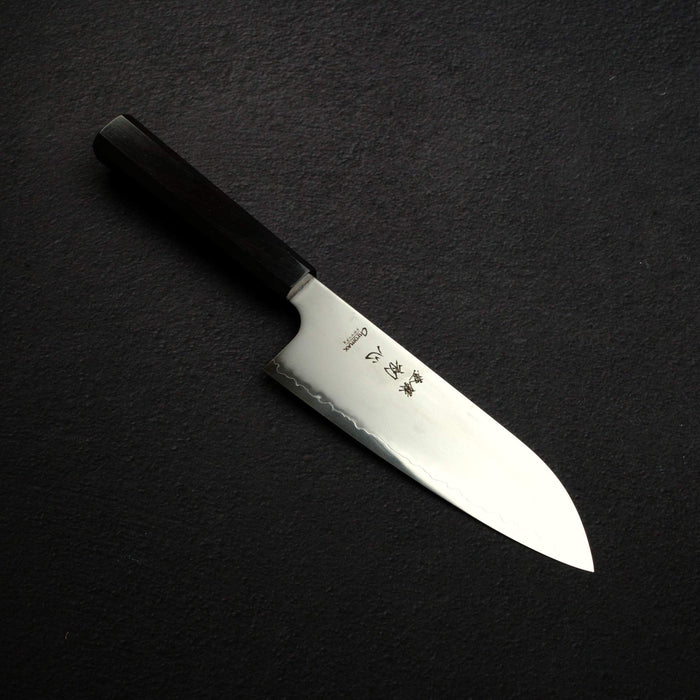
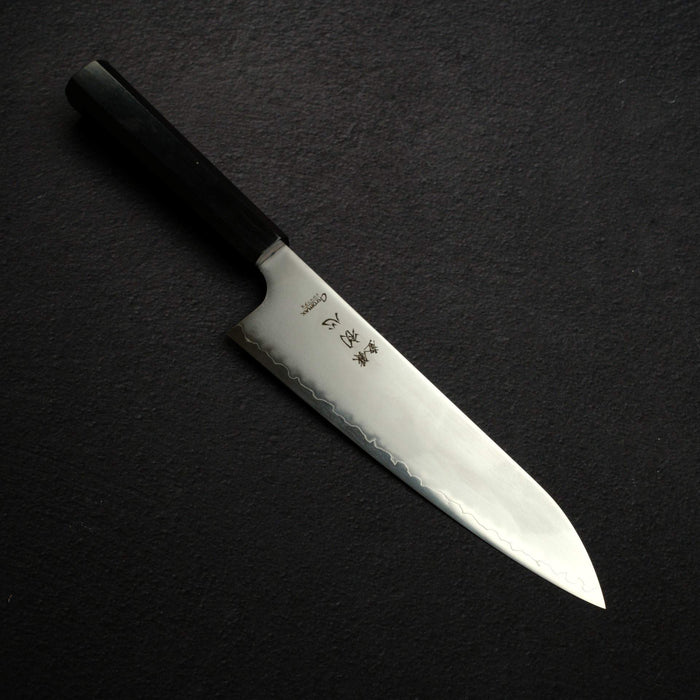
One maker's comparison table says it plainly: a gyuto's tip is sharp and pointed, its edge curves up toward the tip, its length runs 18 to 27 cm; a santoku's tip is slightly rounded, its edge nearly straight, its length 16 to 18 cm. The santoku's spine curves down to a low, dropped tip, often called a sheepsfoot.
That geometry is the difference at the board. The santoku's long flat stretch meets the board along much of the edge, so straight down push-cuts and tap-chops land across the whole width and leave fewer half-cut pieces. The gyuto wants its curve used: a gliding push or a pull stroke through the arc. Its pointed tip does tip work: scoring an onion, separating broccoli into florets, trimming sinew from meat.
3What our measurements show
Shape talk is cheap, so we measured three same-line pairs ourselves: a santoku and a 210 gyuto, same maker, same steel.
| Line | Santoku: edge / heel height / weight | Gyuto 210: edge / heel height / weight |
|---|---|---|
| Hatsukokoro Hayabusa Chromax (santoku 170) | 168 mm / 50 mm / 150 g | 196 mm / 48 mm / 164 g |
| K&S Yuepo SLD Nashiji (santoku 180) | 182 mm / 49 mm / 166 g | 212 mm / 51 mm / 182 g |
| Hatsukokoro Kurogane Blue 2 (santoku 165) | 171 mm / 51 mm / 157 g | 215 mm / 49 mm / 188 g |
Three takeaways. Heel heights sit within 2 to 3 mm of each other, and which knife is taller swaps from pair to pair, so "the santoku is taller" is not a rule. The santoku was lighter in all three pairs, by 14 to 31 g. And a knife sold as a 210 measured 196 to 215 mm of actual edge, so read the measured length, not the name.
4Which one suits your kitchen
Professional cooks favour the gyuto: the length gives reach and range, and volume work shows it. The santoku is the most common knife in Japanese homes. A 2022 survey of 560 women around Japan, run 4 to 17 November among members of parenting-site panels, found 98.0% own a kitchen knife and the santoku the most common type among them, at 96.2%. Women only, one market: a picture of home use, not a census.
If you can own only one knife, the advice depends on who gives it: Japanese makers steer home cooks to the santoku, while shops selling Japanese knives outside Japan tend to say a 210 mm gyuto. Neither is better in the abstract. The rule we use in our shops: choose a gyuto if you want one do-everything knife with more reach, or a santoku if you prefer a compact, easy-to-control blade. Plenty of our customers end up owning both.
In practice: a 160 to 180 mm santoku suits a normal home board and a small kitchen, and it is lighter. The gyuto earns its length on big items, a whole pumpkin or cabbage, large cuts of meat or fish at 240 mm and up, work a santoku must do in sections; a long gyuto is heavier and harder to place in a tight kitchen. Choosing a first Japanese knife has its own page.
5Sizes
For a first gyuto, makers recommend 18 or 21 cm, and we agree with one maker that 21 cm is a well-balanced size: it keeps the gyuto's strengths and still fits a home kitchen. Move to 24 cm for frequent large ingredients, and leave 27 cm for professional kitchens. Traditional sizes run in sun (寸, about 3.03 cm): 6 sun is about 18 cm, 7 sun about 21. Santoku standard is 165 to 180 mm, most often 17 or 18 cm. The gyuto length choice, 210 or 240, has its own page.
7Bunka, K-tip gyuto and nakiri
Three neighbours you will meet while shopping. The bunka is still sold: santoku-sized, with an angled, reverse-tanto point that is better for tip work than a santoku's rounded one. The K-tip gyuto puts that angled tip on a gyuto blade; it is double-bevel and sharpens like any gyuto, whatever it borrows by name from the kiritsuke, a single-bevel cutter. The nakiri is the vegetable knife the santoku partly descends from: rectangular, flat-edged, double-bevel.
8Two myths
A gyuto is only for meat. No. One maker calls this a big misunderstanding: a gyuto cuts meat, fish and vegetables, and its name records an era, not a limit.
A santoku is only for vegetables. No, and its own name is the argument: the three virtues are meat, fish and vegetables in the Japanese reading, and the shape combines a vegetable knife, a fish knife and a chef's knife. Briefly, the other two claims: a santoku is the Japanese home default, common because it is easy, not a lesser knife; and the gyuto's profile is Western, but Japanese gyuto are usually harder, thinner and lighter, so they hold an edge longer and want more care against chipping.
9Questions people actually ask
Which should I buy if I can only have one?
Neither is better in the abstract. Choose a 210 mm gyuto if you want more reach and tip work, or a 165 to 180 mm santoku for easier control in a small kitchen. Japanese makers point home cooks to the santoku, and in our measurements it was the lighter knife in every pair. Plenty of our customers end up owning both.
Can a santoku cut meat?
Yes. The three virtues in its name are read, in Japanese sources, as meat, fish and vegetables, and the shape combines features of a vegetable knife, a fish knife and the chef's knife. For large cuts the longer gyuto is the better tool, because length carries big items, not because the santoku cannot do the work.
What size santoku should I buy?
165 to 180 mm is the standard band, most often 17 or 18 cm, and that footprint suits a normal home board and a small kitchen. Check the measured edge length, not just the name: in our measurements, a santoku sold as a 180 measured 182 mm of edge.
Is a gyuto the same as a chef's knife?
The profile, yes: a gyuto is the Western chef's knife that came to Japan in the Meiji era with meat eating and Western restaurants. The Japanese versions are usually thinner behind the edge, keener and harder than the typical Western knife, so they hold an edge longer and want more care against chipping.
If you would rather hold both, our shops in Crows Nest and Prahran keep a gyuto and a santoku out side by side.
