Crows Nest store now open from Friday to Tuesday, 10am till 6pm.

Mazaki  |  SKU: MAZA_B2MK_YANA300

Mazaki Blue 2 Migaki Yanagiba 300mm w/ Triple Spacer Ebony Handle & Saya

Sale price $15,272.00 Regular price $17,966.00
Tax included Shipping calculated at checkout.

IMPORTANT: Carbon steel knives can rust or patina quickly if not cared for properly. They require regular cleaning, drying, and oiling. If you are unfamiliar with carbon steel maintenance, we recommend choosing a stainless steel option instead.

Availability

  • St Peters
    2 Bishop St Unit 2 St Peters NSW 2044
  • Crows Nest
    107 West St, Crows Nest NSW 2065
    Pickup only
Detailed Specifications
Line Mazaki Blue 2 Single Bevel Migaki
Profile Yanagiba
Bevel Type Single Bevel
Weight 270 g        9.52 oz
Edge Length 293 mm   .11.54 inch
Heel Height 40 mm     .1.57 inch
Width @ Spine 4.7 mm     0.19 inch
Width @ Mid 3.1 mm     0.12 inch
Width @ 1cm from Tip 1.0 mm     0.04 inch
Steel Blue 2 / Aogami #2 | Carbon
Blade Construction Nimai- Soft Iron Clad
Hardness (HRC) 61 - 63
Surface Finish Migaki
Handle triple spacer ebony
Region Sanjo
Best for
  • Enthusiasts
  • Collectors
    • Free shipping for knives over AU$200 Australia wide.
    • World-wide shipping via DHL Express, 3 to 5 days.

    The Mazaki Blue 2 Migaki Yanagiba 300mm with Wenge Saya is a powerful single-bevel slicer from Naoki Mazaki, an independent craftsman working from his workshop in Sanjo, Niigata.

    Forged from Blue 2 carbon steel, this yanagiba offers excellent edge retention, strong cutting feedback and a keen, refined edge suited to sashimi, sushi and precise protein slicing. The long 300mm profile allows smooth, uninterrupted pull cuts, helping preserve the texture and presentation of delicate ingredients.

    The Migaki finish gives the blade a clean, understated appearance, allowing Mazaki’s confident forging and geometry to take centre stage. As with his work more broadly, this yanagiba carries a direct, handmade character — purposeful, robust and highly individual.

    This piece is paired with a K&S Wenge saya, offering practical blade protection while adding a refined aesthetic touch. Dark, elegant and understated, the saya complements the knife’s traditional form and enhances its overall presentation.

    Care Instruction
    1. Don't cut hard things! Japanese knives are brittle so bone hacking is a NO NO!
    2. Wash with neutral detergent after use, and wipe dry;
    3. Please don't wash knife with dishwasher, it will damage the wood handle;
    4. Be careful not to leave the knife close to a heat source for a long time;
    5. It is a lot more dangerous to cut with a blunt knife than a sharp knife!
    6. It is best to sharpen a Japanese knife regularly on a waterstone.
    7. Oil the (carbon) knife if storing for an extended period of time to prevent rust.

    Mazaki

    Mazaki is a one-man operation based in Sanjo, Niigata. His knife is artistically beautful, and from the very beginning with very high level of Fit and Finish. I didn't look further into it as its cutting style was not my preference. 

    A while ago I was able to sample his latest work and was thoroughly impressed by how much it has improved. His knife now cuts much better than his earlier ones. I am particularly impressed that Mazaki's knife is largely finished on a stone by hand, while it is a much more time consuming process, such process ensures the knife is straight and flat with minimal low spots. We are talking about a type of finishing that is very much like Shigefusa's final handle sharpening process (albeit not the same level of polishing), rather than a water grinder sharpening process, which creates uneveness and low spots along the blade road, and sometimes even worse: over-grind. Given the effort that Mazaki-san has put in, the production is understandably very limited, and given the low price, I am sure his work will be highly thought after very soon. 

    • Profile: Yanagiba

      The Yanagiba, often simply called Yanagi, stands as a quintessential knife in the Japanese culinary realm, specifically designed for the artful preparation of sashimi, sushi, and sliced raw fish and seafood. As a member of the Sashimi hōchō family, it is celebrated for its long, slender blade that ensures precision cuts with minimal effort. Blade lengths start at approximately 210mm and can extend up to 360mm, with the 240mm and 270mm sizes being the most favored for home use, while professional kitchens frequently opt for 300mm and larger. This knife's design is not just about aesthetics but about fulfilling the precise requirements of Japanese cuisine, making it a vital tool for both amateur and seasoned chefs.

      Slide for more >>

    • Steel: Blue 2 / Aogami #2

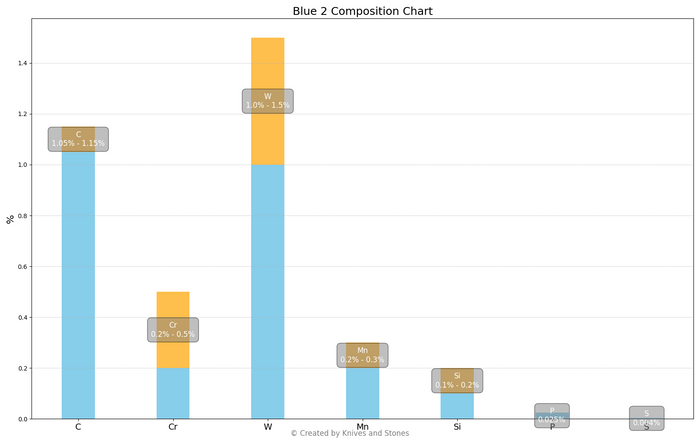
      Blue Steel No.2, also recognized as Aogami No.2, is a distinguished high carbon steel produced by Hitachi Metals Ltd, enhanced by the addition of chromium and tungsten to the base of White Steel No.2. This modification brings about an improvement in toughness and the creation of hard carbide molecules, which significantly boost edge retention. Although its sharpness is comparable to that of White Steel No.2, Blue Steel No.2 offers a slight advantage in maintaining its edge.

      Widely favored for its versatility, Aogami No.2 is celebrated for its ease of sharpening and robust resistance to chipping, making it an ideal choice for those new to Aogami steel knives. Containing 1.0–1.2% carbon and achieving a typical hardness of 62–63 HRC on the Rockwell scale, it stands as the benchmark in evaluating Aogami steel cutlery.

      Manufacturer:

      • Hitachi Special Steel, Japan

      Nature: Carbon

      Hardness: 61- 63

      << Slide for more >>

    • Handle Specs

      Profile: Octagonal WA

      Material:

      • Ebony
      • Marble / Blonde Horn
      • Black Buffalo Horn

      Theis Wa handle design is renowned for its elegant, classic design, making it a sought-after feature in premium knives. This particular handle showcases a triple nickel copper spacer, adding a touch of sophistication. The handle itself is crafted from high-quality ebony, complemented by a horn ferrule that can be either black buffalo horn or a stunning blonde/marble buffalo horn. This meticulous combination of materials not only enhances the knife's aesthetic appeal but also ensures durability and a comfortable grip, making it a favorite among discerning chefs and knife enthusiasts.

      << Slide for more

    Liquid error (sections/product-recommendations line 9): Could not find asset snippets/kns-product-recs.liquid