

Exotic: Yoshikazu Ikeda White #1 Mizu-Honyaki Sakimaru Takohiki 330mm Fujisan Hamon
Exotic: Yoshikazu Ikeda White #1 Mizu-Honyaki Sakimaru Takohiki 330mm Fujisan Hamon is backordered and will ship as soon as it is back in stock.
Availability
Delivery unavailable for this item. Available for in-store pickup only.
-
St Peters, NSW —2 Bishop St, Unit 2, St Peters NSW 2044
-
Crows Nest, NSW —107 West St, Shop 1, Crows Nest NSW 2065Pickup only
-
Prahran, VIC —180 Commercial Road, Shop 1, Prahran VIC 3181Pickup only
Detailed Specifications
| Line | Yoshikazu Ikeda Honyaki |
| Profile | Sakimaru Takohiki / Sashimi Knife |
| Bevel Type | Single Bevel |
| Weight | 254 g 8.96 oz |
| Edge Length | 290 mm .11.42 inch |
| Heel Height | 34 mm .1.34 inch |
| Width @ Spine | 4.2 mm 0.17 inch |
| Width @ Mid | 3.2 mm 0.13 inch |
| Width @ 1cm from Tip | 1.0 mm 0.04 inch |
| Steel | Blue 1 / Aogami #1 | Carbon |
| Blade Construction | Honyaki |
| Hardness (HRC) | 61 - 64 |
| Surface Finish | Mirror Polish |
| Handle | Amboyna Octagonal Horn |
| Region | Sakai |
| Best for |
|
This Yoshikazu Ikeda Sakimaru Takohiki is a 330mm single-bevel sashimi knife forged from Blue 1 carbon steel in a mizu-honyaki construction, best fit for professional slicers requiring long, uninterrupted cuts with a rounded Kanto-style tip. The blade features a Fujisan hamon and mirror polish finish, measuring 4.2mm at the heel and tapering to 1.0mm at the tip across a 290mm edge length. Weighing 254g with a 34mm heel height, this profile draws clean slices through raw fish in one smooth pull while the sakimaru tip remains safe for plating and finishing work.
Blue 1 steel achieves a hardness between 61 and 64 HRC, offering high edge retention and toughness that responds well to sharpening. As a reactive carbon steel honyaki without stainless cladding, the blade requires immediate wiping and drying after use to prevent rust, developing a protective patina over time with proper care. Yoshikazu Ikeda, president of the Sakai Uchihamono Traditional Craftsmen Association and certified Traditional Craftsman since 1988, forged this knife in Sakai using traditional differential hardening techniques specific to his honyaki specialisation.
- Don't cut hard things! Japanese knives are brittle so bone hacking is a NO NO!
- Wash with neutral detergent after use, and wipe dry;
- Please don't wash knife with dishwasher, it will damage the wood handle;
- Be careful not to leave the knife close to a heat source for a long time;
- It is a lot more dangerous to cut with a blunt knife than a sharp knife!
- It is best to sharpen a Japanese knife regularly on a waterstone.
- Oil the (carbon) knife if storing for an extended period of time to prevent rust.

-

Profile: Sakimaru Takohiki
Sashimi Knife
Slide for more >>
-
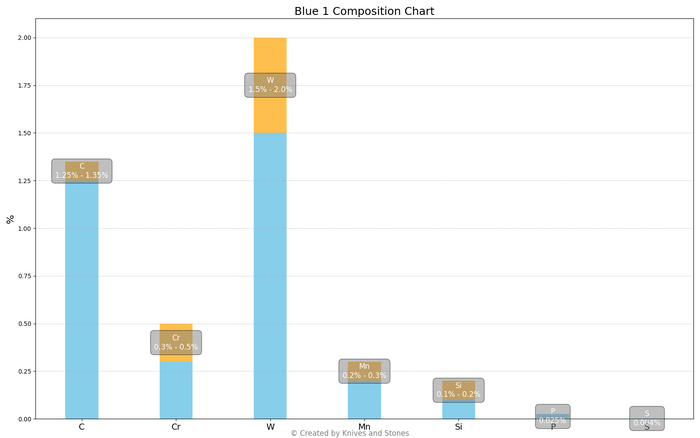
Steel: Blue 1 / Aogami #1
Manufacturer:
Nature: Carbon
Hardness: 61- 64
<< Slide for more >>
-
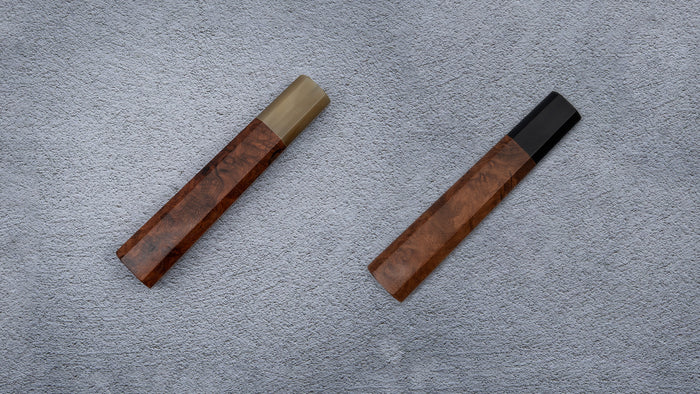
Handle Specs
Profile: Octagonal WA
Material:
<< Slide for more