Konro and hibachi grills: what they are, which size to buy, and how to run one

1Konro, hibachi or shichirin: what's the difference?
These three words get used interchangeably, and most of them point at the same grill in practice. "Hibachi" is what most Australian buyers search for, and it is what the casual trade calls any small charcoal grill of this shape. In strict Japanese usage a konro is the grill itself, a box or tub of fired earth, which is what this guide and our collection pages cover.
What matters when you buy is the shape and the material, not the word. Every product under any of these names on our site is the same family: a diatomite charcoal box that runs binchotan close under the food.
2What is a konro grill, and why is it made of diatomaceous earth?
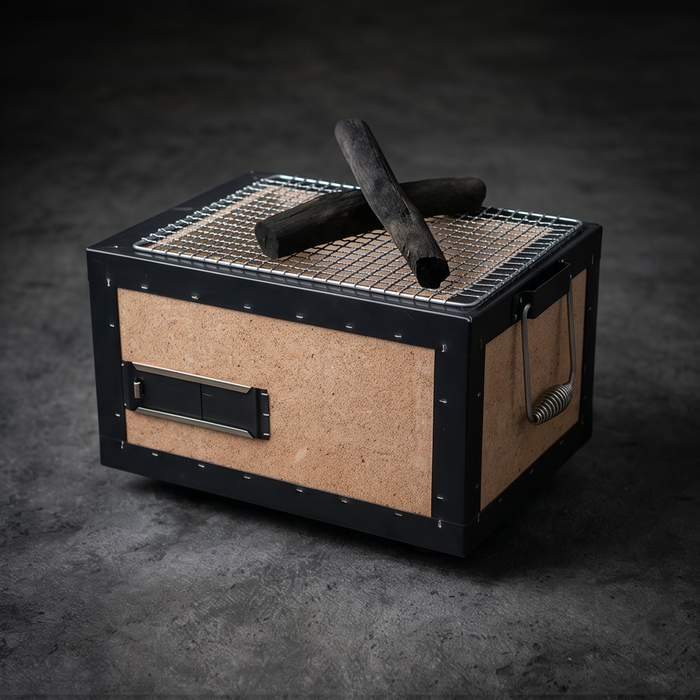
A konro is a charcoal box with walls of fired diatomaceous earth, a soft sedimentary rock full of microscopic voids. Kinka, the maker behind the Okunoto line, describes the material this way: the diatomite has very many internal voids, a porous structure, and excellent insulation, and its refractoriness is relatively high, around 800 to 1000 degrees Celsius. That last figure is what the body withstands, not what it stores. The mechanism is insulation. Raw diatomite has a low thermal conductivity, around 0.05 to 0.10 W/m.K in peer-reviewed measurements (MDPI Materials 2023, 16(11):4028), meaning its porous silica structure resists heat passing through the wall. So the heat goes up into the food rather than out into the bench, and a small fire stays useful for a long time on a modest handful of coals.
The earth itself comes from the Noto Peninsula in Ishikawa prefecture. Suzu, at the tip of the peninsula, holds Japan's largest diatomite deposits. Kinka states that its grills are made from 100 percent Noto diatomite, and that the bodies are mixed with water, kneaded, moulded, dried, fired and finished at its factory in Hekinan, Aichi prefecture. So the material is Noto earth, and the grill is a moulded and kiln-fired body rather than a block cut out of the quarry, which is the older Suzu tradition for round shichirin.
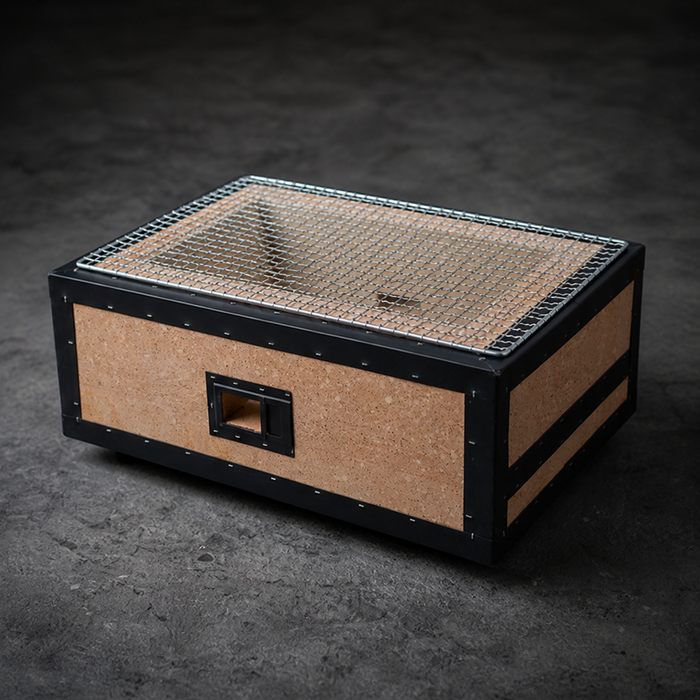
Two shapes matter when you choose. The narrow grills (230 mm deep) are the yakitori shape: skewers rest across the walls with the handles off the fire. The wide grills (350 mm deep) give you a proper cooking area for fish, vegetables and steak.
One number to put straight. You will see "1200 degrees" quoted around binchotan grilling. That figure is a manufacturing temperature: binchotan is made by charring wood in a kiln at roughly 1000 to 1200 C, then smothering it with soil, sand and ash in the shiro-oshi whitening step that gives it the pale coat. It is a production figure, not a cooking figure. What happens on your grill is this: in use, the binchotan bed runs at about 800 to 1000 C. That is the same range as the body's refractoriness above, but it is a different measurement, one is the fuel's working temperature and the other is what the earth tolerates, and they should not be read as the same number.
3If a cheap hibachi works, why do serious cooks use these?
The honest answer starts with Japan: konro and shichirin grilling is the standard format in yakitori restaurants there, the way a kitchen grill is taken for granted, and the reason it works as a professional format is the body. The insulation lets a small charcoal bed cook close under the food for hours without baking whatever it is standing on. Binchotan in that bed runs about 800 to 1000 C and burns for 3 to 5 hours, against 1 to 1.5 hours for conventional charcoal. A thin-walled decorative hibachi does the first few skewers; it is the sustained, close, controllable heat over a long service that the diatomite body is built for.
4Which size konro do I need for how many people?
Count the people first, then decide narrow or wide. The six Okunoto sizes:
| Size | External dimensions | Grill weight | People | Price |
|---|---|---|---|---|
| Small | 310 x 230 x 200 mm | 6.5 kg | 2 to 4 | $8,330.00 |
| Medium | 540 x 230 x 200 mm | 11 kg | 4 to 8 | $12,033.00 |
| Medium Wide | 470 x 350 x 200 mm | 14 kg | 4 to 8 | $13,884.00 |
| Large | 770 x 230 x 200 mm | 15 kg | 6 to 12 | Currently out of stock |
| Large Wide | 690 x 350 x 200 mm | 20 kg | 6 to 12 | $16,661.00 |
| Extra Large Wide | 930 x 350 x 200 mm | 25 kg | 8 to 14 | Currently out of stock |
Medium and Medium Wide both suit 4 to 8 people, so the choice between them is what you cook. Medium is the yakitori grill: long, narrow, skewers across the walls. Medium Wide is the same capacity laid out as a cooking surface, which is what you want for fillets, mushrooms and thicker cuts.
The Large is currently unavailable.
If you are buying your first one and cook for a family of four, the Small handles skewers for a weeknight and the Medium is the size most people end up wishing they had bought.
Starter sets bundle a grill with binchotan and a steel chimney: the Small set at$10,772.00and the Medium set atCurrently out of stock.
Every size is 200 mm tall, so they all sit at the same working height on a table. The weights are the maker's catalogue figures for the grill itself; packed for shipping each one is a kilogram or two heavier.
5What comes with the grill, and which replacement net fits which size?
The net is a consumable and it is sized to the grill, so buy it by size code rather than by eye. The reusable steel mesh:

| Grill | Net variant | Price |
|---|---|---|
| Small | for Small Hibachi BQ8F | $17.95 |
| Medium | for Medium Hibachi BQ8WF | $29.95 |
| Medium Wide | for Medium Wide Hibachi BQ12 | $34.95 |
| Large | for Long Hibachi BQ8T, 2 pieces | $39.95 |
| Large Wide | for Large Wide Hibachi BQ17 | $79.95 |
| Extra Large Wide | not stocked; an 800 x 300 mm replacement net exists for the BQ22 in Japan | ask us |
The Large takes two pieces because the grill is 770 mm long and the mesh is not. The reusable mesh is steel and dishwasher safe: wash it with detergent and dry it, or it will rust.
Net sizes for the two wide grills: the Medium Wide net is 450 x 300 mm and the Large Wide net is 620 x 300 mm (Kinka part CP-34). The Extra Large Wide takes an 800 x 300 mm net (810 x 310 mm measured), made by Nagata Kanaami for the BQ22, which we do not currently stock.
The grill is sold as the body; the net for your size is in the table above. No trivet or charcoal tray is included with any size.
6Can I use a konro indoors or on a balcony?
Never indoors. Charcoal produces carbon monoxide, which you cannot see or smell, and a room does not have to be small for it to reach a level that will kill you. Our own care instructions say to use the grill in well ventilated areas to avoid potential carbon monoxide poisoning, and that means outdoors, with open air above the grill.
Balconies in Australia are a strata question before they are a safety question. Charcoal barbecues are commonly banned outright on apartment balconies by strata by-laws, and published schemes exist whose by-laws state residents must not use a barbecue fired by charcoal, briquettes or wood on a balcony. Smoke drifting into a neighbour's flat can also be treated as a nuisance. Read your own scheme's by-laws and your lease before you buy, because the answer is set by the building, not by the grill.
Wherever you run it, put a heat resistant mat under it. The walls insulate well, but the base still transfers heat into a timber table.
7What charcoal do I use, and how much?
Binchotan, and only enough to cover the bottom of the grill. Anything more than a single layer gives you excessive heat and flame, which is the opposite of what this grill is for. Binchotan is Japanese white charcoal: dense, almost pure carbon, very little smoke, and it holds a steady radiant heat instead of flaring. A bed of it burns for 3 to 5 hours, against 1 to 1.5 hours for conventional charcoal, which is what makes a long evening of cooking realistic on one light-up.

Give yourself time to light it. Expect 30 to 45 minutes to bring binchotan up in a chimney. It is ready when the pieces glow red under a coat of white ash. Lighting it in the grill itself is slower and harder on the diatomite, so use a chimney over a gas burner or firelighters and tip the coals in when they are lit.
8How do I look after it, and what counts as normal wear?
Never put water on the coals or on the body. Diatomite absorbs water and becomes brittle, and a sudden change in temperature cracks it. This is the one rule that ruins grills. To put the fire out, lift the coals into a charcoal extinguishing pot or let them burn down, then let the grill go cold on its own.
Cleaning is dry work. Once it is completely cold, gently remove the ash and food residue, and avoid washing the grill with water.
Cracks are not all the same thing. Fine cracks in the trivet are normal with regular use, and the trivet is a consumable that gets replaced every one to two years. A crack in the grill body is different: stop using it. Store it dry and indoors between cooks, because damp is what turns a hairline into a break.
The warranty covers replacement of a product that arrives defective. It does not cover mishandling, and water is the usual mishandling.
9Where can I buy one in Australia, and can I pick it up?
We have physical stores in Sydney, Melbourne and Canberra, so you can see the size in person before committing to 6.5 to 25 kg of fired earth, and collect rather than ship if that suits you better. If you would rather have it delivered, email us for a postage quote with the size and your postcode; these are heavy items and the quote depends on both.
10Questions people ask
What is the difference between a konro and a hibachi grill?
In Australian shop practice the words point at the same grill: a small charcoal box, usually of diatomaceous earth, cooking close under the food. Konro is the precise word for the grill itself; hibachi is what most buyers search for. Buy on shape and size, not on the name.
If a cheap hibachi works, why buy a proper konro?
The diatomite body insulates rather than conducts, so a small binchotan bed cooks close under the food for hours without baking the bench. Binchotan burns 3 to 5 hours against 1 to 1.5 hours for conventional charcoal. This is the standard setup in Japanese yakitori restaurants, and it is the sustained heat that makes the difference.
Can I use a konro grill indoors?
No. Burning charcoal produces carbon monoxide, which is colourless and odourless. Use it outdoors in open air, on a heat resistant mat.
What size konro do I need for four people?
The Small (310 x 230 mm,$8,330.00) covers 2 to 4 people. If four is your regular number rather than your maximum, the Medium (540 x 230 mm,$12,033.00) is rated for 4 to 8 and gives you room to cook in batches without crowding the fire.
What charcoal goes in a konro grill?
Binchotan, laid one layer deep so it just covers the bottom. Allow 30 to 45 minutes to light it in a chimney. It is ready when the pieces glow red under white ash.
Can I wash a konro grill?
No. Diatomaceous earth absorbs water and goes brittle, and water on hot coals cracks the body. Let it go cold, then gently brush out the ash. The steel net can go in the dishwasher, then dry it to stop it rusting.
My konro has a crack. Is it still usable?
A cracked trivet is normal wear and gets replaced every one to two years. A crack in the grill body means stop using it.