
Honyaki vs Monosteel: What Makes a Real Honyaki?
1What makes a knife a honyaki
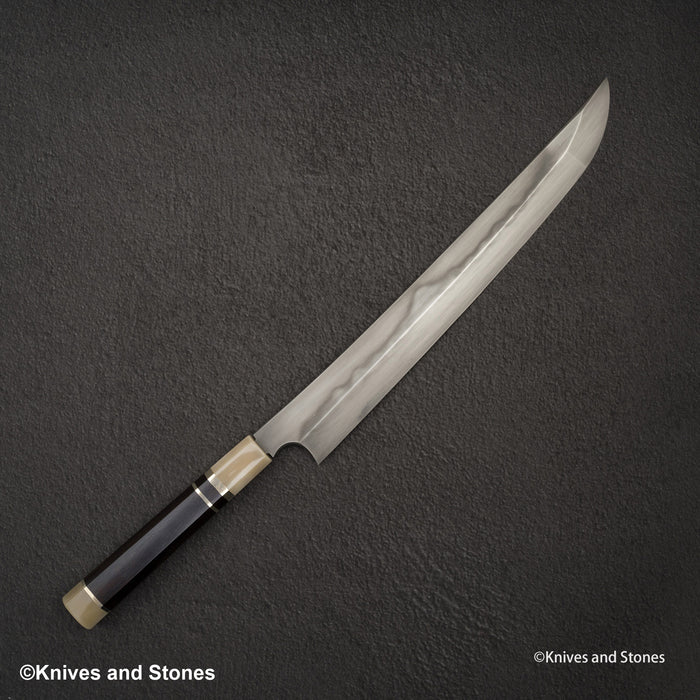
The strict definition is old and specific: a true 本焼 is made only of hard steel (hagane), forged, and quenched the way a sword is. Clay is packed on the flats and spine. Under the clay the steel cools more slowly, so the edge reaches full hardness while the body behind it stays tougher and softer. The hardness difference leaves a visible trace, the hamon (刃文, the temper line), and the knife's name comes from its resemblance to that sword quench. The honyaki construction page shows the geometry.


The hamon's position tells you which knife you are looking at: on a honyaki it runs roughly mid-blade toward the spine, where the clay line sat. A line near the edge is not a hamon, it is the boundary between core steel and soft cladding on a clad (kasumi or awase) knife, a construction line, not a fire line. The White vs Blue steel page covers the carbon steels a honyaki is traditionally made from.
The craft shows in the price: a honyaki costs close to three times what a forge-welded clad knife in the same steel costs.
2Water or oil: mizu-honyaki and abura-honyaki
The trade names the two ways to quench a honyaki. A water quench (水本焼, mizu-honyaki) cools fast: harder, longer-holding edge, but blades can crack in the quench, and even skilled smiths lose some, which is why makers forge extras. An oil quench (油本焼, abura-honyaki) cools slower: lower cracking risk, slightly less hard, often a clearer hamon. Neither wins outright. It is a trade between edge and risk.
The classic steels for either are carbon: White (Shirogami) and Blue (Aogami). One Sakai maker water-quenches Blue 1, Blue 2, White 1 and White 2, and oil-quenches White 3.
3What monosteel is
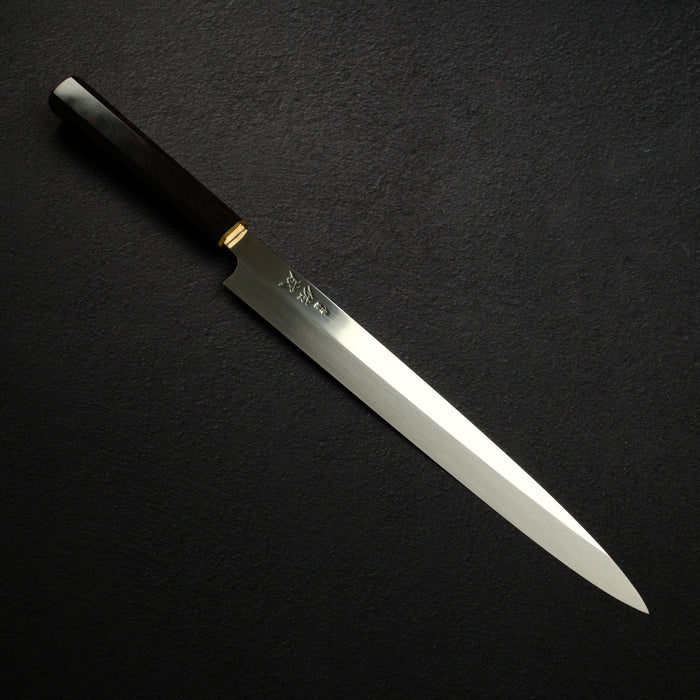
Monosteel is one piece of steel, stamped or forged to shape and quenched through its whole thickness, the way a Western knife is hardened. The Japanese word for it is 全鋼 (zenkō, "all steel"). At least one Sakai maker states plainly that 全鋼 is a completely different thing from 本焼, because it is not forged and not clay-quenched. Our monosteel construction page covers the build. Monosteel comes in stainless and in carbon, and the two need different care (more on that below).
4Why some monosteel is sold as "honyaki"
The word 本焼 is used loosely in the trade: some makers list stainless Ginsan and VG10 knives as 本焼, and some sellers put 全鋼本焼 on vacuum-hardened powder steels like ZDP-189. We have not found a clay hamon on a stainless knife. The stainless knives sold this way show almost none, and the faint lines people point to are explained as quench-temperature variation, not clay. A visible line can also be brought out cosmetically by polishing. That is not proof it can never be done, but we have not seen it. The powder steels are compared in SG2 vs ZDP-189.
Sukenari is the example on our own shelves. Its own site uses 本焼 for its carbon steel series only; the SG-Ⅱ, ZDP-189 and HAP-40 are listed as series, not 本焼. So "SG2 Honyaki" is trade and retail usage, not the maker's own claim.
Our naming policy is this. We keep "Honyaki" in the product title because that is the name the knife is sold under in the trade, and we label its construction as monosteel on the Knife details card. The Sukenari SG-2 Honyaki Migaki is the example we sell: to us it is a monosteel, and the card says so.
5Stainless vs carbon monosteel: care and sharpening
Carbon steel rusts if it is left wet, and it builds a patina with use: wipe it dry after each use. Stainless resists rust but is not rust-proof, so it still wants the same wipe. Details are on our rust and patina care page.
Sharpening is where monosteel of either kind asks something of you: a blade that is hard steel all the way through, honyaki or monosteel, is slower to thin and to sharpen than a clad blade, where only the core is hard. A honyaki can also crack, or even snap, under careless force.
6How to tell a real honyaki
Four checks, and none of them is the label.
Where the line sits. A hamon mid-blade toward the spine says differential hardening. A line near the edge says clad construction.
What the maker says. A real honyaki's description mentions clay and a water or oil quench, and the steel is usually White or Blue. "Honyaki" as the only relevant word, with a stainless steel and no quench story, tells you what the knife is.
What the spec says. A spec that lists vacuum hardening and no clay or quench medium describes through-hardening: monosteel. That is fine if you know which you are buying.
The price. A real honyaki costs close to three times a clad knife in the same steel. A "honyaki" priced like the clad knife deserves a second look.
One honest caveat: a real honyaki can carry a faint or invisible hamon and still perform fully, so an invisible line is not proof of a fake. A strong line on its own proves nothing either, because polishing can bring one out.
7The two side by side
| Honyaki | Monosteel | |
|---|---|---|
| Construction | One hard steel, forged, clay-painted before the quench | One steel, stamped or forged, no clay |
| Heat treatment | Differential: edge hard, body softer; water or oil quench | Through-hardened: one hardness from edge to spine |
| Hamon | Yes, mid-blade toward the spine; may be faint or invisible | None from the quench; a visible line can be cosmetic |
| Typical steels | White and Blue carbon | Carbon or stainless: Ginsan, VG10, SG2, ZDP-189, HAP-40 |
| Care | Carbon: wipe dry, expect patina | Carbon: same. Stainless: resists rust, still wipe it |
| Thinning and sharpening | Slow work, steel throughout; can crack under force | Same slow work, steel throughout |
| Price | Close to 3x a clad knife in the same steel | Set by the steel and the maker |
8Which one to buy
If you sharpen your own knives and you want a sword-style hardened edge and the craft that made it, a honyaki is your knife. Accept the sharpening work and the care it needs, and accept that one careless moment can crack it.
If you want the knife that needs the least rust care, take a stainless monosteel. It will not thin or sharpen quickly, but it asks little else of you, and an honest monosteel in good steel is no one's consolation prize.
9Questions people actually ask
Is SG2 honyaki real honyaki?
To us, no: it is a monosteel. SG2 is hardened through, without clay or a differential quench. The name "Honyaki" in the title is the name the knife trades under, and our Knife details card labels the construction as monosteel. It is still a very good knife; we just tell you which one it is.
Can stainless steel be honyaki?
We have not found a stainless knife with a clay hamon. Stainless knives sold as honyaki show almost none, and the faint lines on them are explained as quench variation rather than clay. We would not say the door is closed forever, but nothing we have seen walks through it.
What is the difference between mizu-honyaki and abura-honyaki?
Water quench or oil quench. Water cools faster, giving a harder, longer-holding edge, but blades can crack in the quench and smiths lose some. Oil is safer, slightly less hard, and often shows a clearer hamon.
Is honyaki harder than other knives?
Often run harder, yes, but not automatically: one sharpener has found another maker's honyaki unusually soft, and even a major maker says a honyaki does not beat every clad knife. We do not print a hardness number for the category, because there is no honest one.
If you would rather hold both, come into our Crows Nest or Prahran shop. A hamon reads differently under a shop light than in any photo.
