Crows Nest store now open from Friday to Tuesday, 10am till 6pm.

Mazaki  |  SKU: MAZA_W2KU_GY24

Mazaki White 2 Kurouchi Gyuto 240mm

Regular price $10,251.00
Tax included Shipping calculated at checkout.

IMPORTANT: Carbon steel knives can rust or patina quickly if not cared for properly. They require regular cleaning, drying, and oiling. If you are unfamiliar with carbon steel maintenance, we recommend choosing a stainless steel option instead.

Availability

  • St Peters
    2 Bishop St Unit 2 St Peters NSW 2044
  • Crows Nest
    107 West St, Crows Nest NSW 2065
    Pickup only
Detailed Specifications
Line Mazaki White 2 Kurouchi
Profile Gyuto / Chefs Knife
Bevel Type Double Bevel
Weight 234 g        8.25 oz
Edge Length 249 mm   .9.8 inch
Heel Height 54 mm     .2.13 inch
Width @ Spine 5.7 mm     0.22 inch
Width @ Mid 2.1 mm     0.08 inch
Width @ 1cm from Tip 1.0 mm     0.04 inch
Steel White 2 / Shirogami #2 | Carbon
Blade Construction Sanmai - Soft Iron Clad
Hardness (HRC) 60 - 64
Surface Finish Kurouchi
Handle Octagonal Ebony Blonde Horn
Region Sanjo
Best for
  • Enthusiasts
  • Pro chefs
    • Free shipping for knives over AU$200 Australia wide.
    • World-wide shipping via DHL Express, 3 to 5 days.

    The Mazaki White 2 Kurouchi Gyuto 240mm is a double-bevel chef's knife forged entirely by Naoki Mazaki in Sanjo, best fitting users seeking a reactive carbon steel blade with hand-finished geometry. This 240mm gyuto features a kurouchi surface finish and sanmai construction with soft iron cladding over a Shirogami #2 core. The blade measures 54mm at the heel height, tapers from 5.7mm at the spine to 1.0mm at the tip, weighs 234g, and has an edge length of 249mm.

    Shirogami #2 steel offers high sharpness and ease of sharpening while requiring immediate wiping and drying after use to prevent corrosion due to its reactive nature. As a general-purpose profile, this gyuto suits mincing, slicing, and chopping vegetables or meat in professional and home kitchens. Naoki Mazaki operates as a one-man forge where every knife is forged, ground, heat-treated, and finished entirely by hand, ensuring each blade is straight and flat through meticulous stone finishing. This complete solo production process defines the fit and finish characteristics of this specific tool.

    Care Instruction
    1. Don't cut hard things! Japanese knives are brittle so bone hacking is a NO NO!
    2. Wash with neutral detergent after use, and wipe dry;
    3. Please don't wash knife with dishwasher, it will damage the wood handle;
    4. Be careful not to leave the knife close to a heat source for a long time;
    5. It is a lot more dangerous to cut with a blunt knife than a sharp knife!
    6. It is best to sharpen a Japanese knife regularly on a waterstone.
    7. Oil the (carbon) knife if storing for an extended period of time to prevent rust.

    Mazaki

    Mazaki is a one-man operation based in Sanjo, Niigata. His knife is artistically beautful, and from the very beginning with very high level of Fit and Finish. I didn't look further into it as its cutting style was not my preference. 

    A while ago I was able to sample his latest work and was thoroughly impressed by how much it has improved. His knife now cuts much better than his earlier ones. I am particularly impressed that Mazaki's knife is largely finished on a stone by hand, while it is a much more time consuming process, such process ensures the knife is straight and flat with minimal low spots. We are talking about a type of finishing that is very much like Shigefusa's final handle sharpening process (albeit not the same level of polishing), rather than a water grinder sharpening process, which creates uneveness and low spots along the blade road, and sometimes even worse: over-grind. Given the effort that Mazaki-san has put in, the production is understandably very limited, and given the low price, I am sure his work will be highly thought after very soon. 

    • Profile: Gyuto

      Chefs Knife

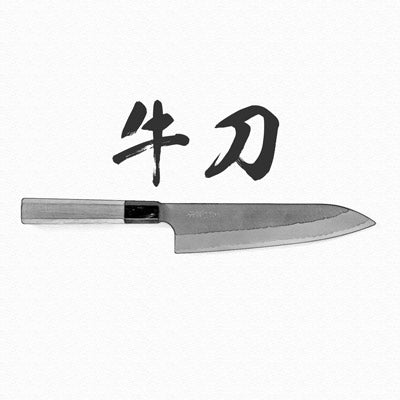
      A Japanese chef's knife is known as a gyuto (牛刀 ぎゅうとう) gyūtō), literally meaning 'beef knife'. Its blade resembles a flatter version of a French chef's knife. Japanese cutlery is known for sharpness due to its acute blade geometry, and the hardness of the steel used, sometimes exceeding 60 HRC on the Rockwell Scale A typical western chef's knife may be sharpened to an edge angle of 20-22°, while a Japanese gyuto generally has a sharper edge angle of 15-18° (or even lower), which requires a harder, more brittle grade of steel. In recent years Japanese gyuto have gained in popularity with western chefs.

      A modern chef's knife is a multi-purpose knife designed to perform well at many differing kitchen tasks, rather than excelling at any one in particular. It can be used for mincing, slicing, and chopping vegetables, slicing meat, and disjointing large cuts.

      Slide for more >>

    • Steel: White 2 / Shirogami #2

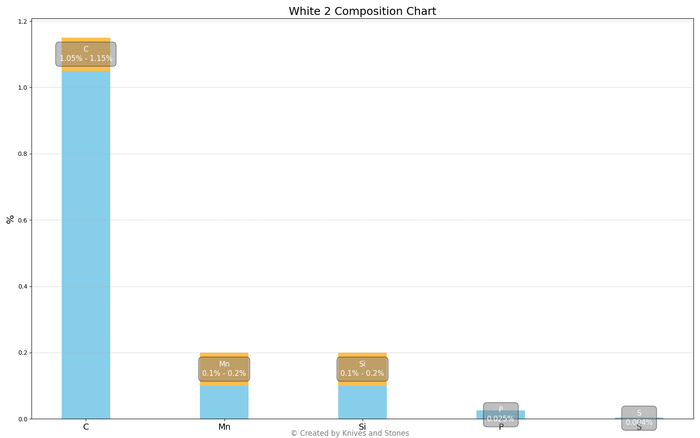
      White Steel No.2, also known as Shirogami #2 or White Paper #2, is long regarded as the go-to choice for crafting high-grade Japanese kitchen knives. This steel is celebrated for its capacity to be fashioned into knives that exhibit a sharp cutting edge, moderate tenacity, and long-lasting sharpness, alongside being notably easy to sharpen. While it possesses a slightly lower carbon content (C: 1%) compared to White Steel No.1 (C: 1.3%), it still requires a high level of craftsmanship to manipulate effectively. The expertise of a skilled blacksmith is crucial in transforming this material into a premium quality kitchen knife. Despite its excellent qualities, White Steel No.2 is known to be very reactive; hence, knives made from this steel demand meticulous care, including immediate wiping and drying after use, to prevent corrosion.

      Sanjo and Sakai are known to widely utilise Shirogami #2 in their mainstream kitchen knives.

      Manufacturer:

      • Hitachi Special Steel, Japan

      Nature: Carbon

      Hardness: 60- 64

      << Slide for more >>

    • Set of six wooden objects with black and brown finishes on a gray surface

      Handle Specs

      Profile: Octagonal WA

      Material:

      • Ebony

      The K&S Octagonal Ebony Handle with Blonde/Marble Ferrule is a premium custom handle designed to elevate both the performance and aesthetics of your Japanese kitchen knife. Crafted from solid ebony, the handle features a deep, rich black tone that is not only visually striking but also provides a dense, durable, and well-balanced feel in hand. The octagonal shape offers an ergonomic grip, ensuring comfort and control for both right- and left-handed users.

      Complementing the dark elegance of ebony, the ferrule is fitted in either natural blonde or marble-patterned horn, creating a beautiful contrast that highlights the handcrafted character of the handle. Each ferrule is slightly different, giving every piece a one-of-a-kind personality.

      Combining traditional Japanese design with refined materials, this handle is ideal for replacing or upgrading the stock handle of your knife, delivering both functional stability and timeless sophistication.

      << Slide for more

    Liquid error (sections/product-recommendations line 9): Could not find asset snippets/kns-product-recs.liquid