

Nigara Blue 2 Honyaki Dual Hamon Kiritsuke Yanagiba 300mm
Nigara Blue 2 Honyaki Dual Hamon Kiritsuke Yanagiba 300mm is backordered and will ship as soon as it is back in stock.
Availability
Delivery unavailable for this item. Available for in-store pickup only.
-
St Peters, NSW —2 Bishop St, Unit 2, St Peters NSW 2044
-
Crows Nest, NSW —107 West St, Shop 1, Crows Nest NSW 2065Pickup only
-
Prahran, VIC —180 Commercial Road, Shop 1, Prahran VIC 3181Pickup only
Detailed Specifications
| Line | Nigara Honyaki |
| Profile | K-tip Yanagiba / Sashimi Knife |
| Bevel Type | Single Bevel |
| Weight | 308 g 10.86 oz |
| Edge Length | 287 mm .11.3 inch |
| Heel Height | 41 mm .1.61 inch |
| Width @ Spine | 5.0 mm 0.2 inch |
| Width @ Mid | 4.0 mm 0.16 inch |
| Width @ 1cm from Tip | 1.2 mm 0.05 inch |
| Steel | Blue 2 / Aogami #2 | Carbon |
| Blade Construction | Honyaki |
| Hardness (HRC) | 61 - 63 |
| Surface Finish | Etched |
| Handle | triple spacer ebony |
| Region | Aomori |
| Best for |
|

The Nigara Blue 2 Honyaki Dual Hamon Kiritsuke Yanagiba 300mm is a single-bevel sashimi knife best fit for professionals preparing raw fish and seafood who require a long blade with precise tip control. Forged by Go Yoshizawa in Aomori, this honyaki construction features an etched surface finish and a dual hamon pattern. The kiritsuke yanagiba profile presents a flatter geometry and clearly defined tip that enhances slicing capability while enabling fine cutting work with the front section of the blade.
This 300mm knife measures 41mm in heel height with a spine thickness of 5.0mm at the heel, tapering to 1.2mm at the tip, and weighs 308g. The carbon steel core is Hitachi Blue 2 (Aogami #2), hardened to 61-63 HRC with 1.1% carbon and 1.25% tungsten content for improved edge retention and toughness. As a reactive carbon steel honyaki blade without stainless cladding, it requires immediate drying after use and light oiling to prevent oxidation. The single-bevel geometry suits traditional Japanese slicing techniques for sashimi preparation, and the substantial spine provides the mass necessary for controlled draw-cutting through protein.
- Don't cut hard things! Japanese knives are brittle so bone hacking is a NO NO!
- Wash with neutral detergent after use, and wipe dry;
- Please don't wash knife with dishwasher, it will damage the wood handle;
- Be careful not to leave the knife close to a heat source for a long time;
- It is a lot more dangerous to cut with a blunt knife than a sharp knife!
- It is best to sharpen a Japanese knife regularly on a waterstone.
- Oil the (carbon) knife if storing for an extended period of time to prevent rust.

-

Profile: K-tip Yanagiba
Sashimi Knife
Slide for more >>
-
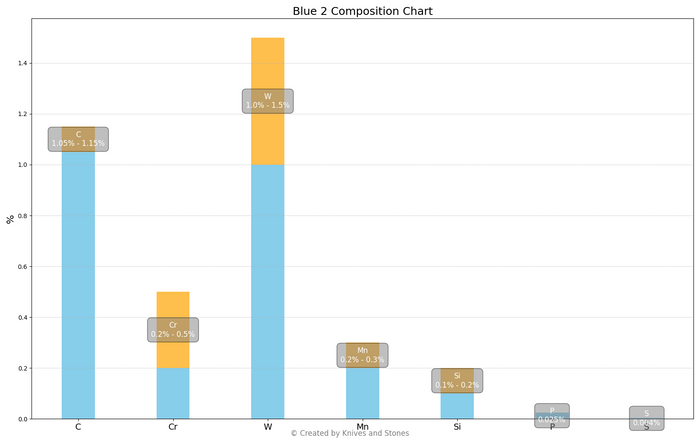
Steel: Blue 2 / Aogami #2
Manufacturer:
Nature: Carbon
Hardness: 61- 63
<< Slide for more >>
-

Handle Specs
Profile: Octagonal WA
Material:
<< Slide for more