PRAHRAN STORE NOW OPEN · THU–MON · 10AM–6PM

Kisuke Manaka  |  SKU: KISU-ATS34TSMK-PT180-XG

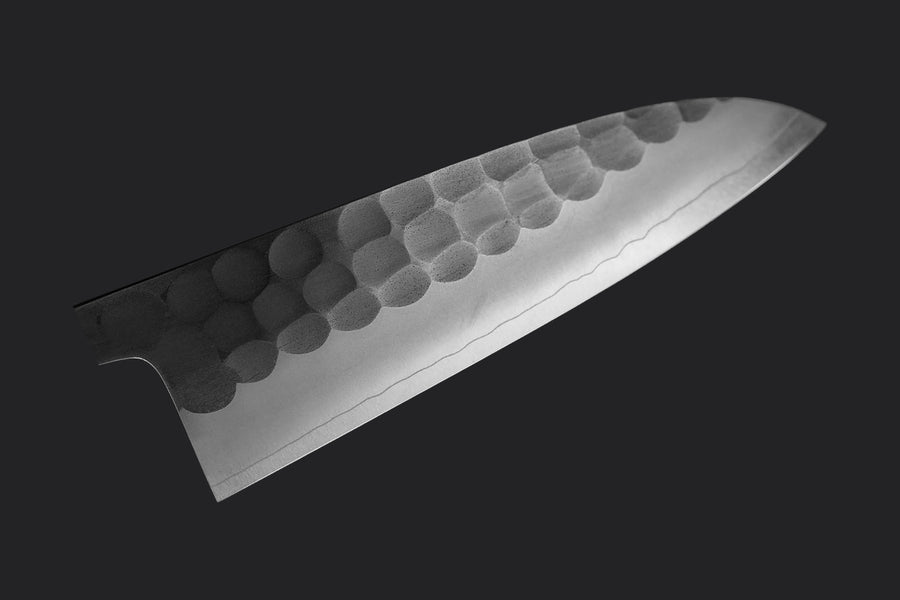
Kisuke x Xinguo ATS34 Petty Tsuchime Mirror Kasumi Finish 180mm w Knife Guard

Regular price $13,306.00

Sold out right now

Leave your email and we’ll send one message the moment it’s back in stock.

One email, no marketing. Privacy policy.

Availability

  • St Peters, NSW —
    2 Bishop St, Unit 2, St Peters NSW 2044
  • Crows Nest, NSW —
    107 West St, Shop 1, Crows Nest NSW 2065
    Pickup only
  • Prahran, VIC —
    180 Commercial Road, Shop 1, Prahran VIC 3181
    Pickup only
Detailed Specifications
Line Manaka ATS34 x Xinguo
Profile Petty / Utility knife
Bevel Type Double Bevel
Weight 132 g | 4.7 oz
Edge Length 177 mm | 6 31/32″
Heel Height 34 mm | 1 11/32″
Width @ Heel 2.4 mm | 3/32″
Width @ Mid 2.4 mm | 3/32″
Width @ 1cm from Tip 1.2 mm | 3/64″
Steel ATS34 | Stainless
Blade Construction Warikomi - Stainless Clad
Hardness (HRC) 60 - 61
Surface Finish Tsuchime
Handle Special Handle
Region Sanjo
Best for
  • Enthusiasts
  • Collectors
  • Free shipping for knives over AU$200 Australia wide.
  • World-wide shipping via DHL Express, 3 to 5 days.


This is what happens when two very different skill sets come together and the result is greater than the sum of its parts. Kisuke Manaka hand-welds and forges each blade using ATS-34 stainless core steel in a traditional hon-warikomi (true insert) construction — a method honed over twenty years at the family forge, now practiced in Sanjo. On the other end, Xinguo, an emerging bladesmith from China who's been quietly building a serious reputation, takes over with finishing work that is frankly on another level.

If Xinguo's name rings a bell, it might be because he handled the sharpening on our last batch of Manaka ENN Damascus. His sharpening and polishing work is immaculate — on these blades, you won't find a single visible machining line. The edge comes out extremely straight, the choil and spine are polished and rounded to a degree that makes the knife genuinely comfortable to choke up on, and the deep tsuchime (hammered) texture across the blade face adds both visual character and food release. It's a high-polish, high-effort finish that you rarely see at any price point.

In the hand, these are hefty, no-nonsense workhorses. They run long, tall, and carry real weight — the kind of knives that feel planted on the board and power through dense roots and heavy prep without flinching. But despite the robust build, the cutting performance is surprisingly refined. ATS-34 is a well-proven stainless steel that holds an edge reliably and sharpens up without drama, making it a practical choice for cooks who want a knife that works as hard as they do.

The lineup covers pretty much the full range — gyuto, petty, chuka, santoku and more — so there's something here regardless of your preferred profile. These sit firmly in the high-budget category, but for a hand-forged Manaka with this level of finishing, the proposition is a compelling one. Collectors and enthusiasts who value the intersection of traditional Japanese forging and exceptional hand-finishing will find a lot to love here.

Pros Cons
  • Excellent performance
  • Great artistic
  • Highly collectable
  • Mirror polish can be hard to maintain
  • High budget
Care Instruction
  1. Don't cut hard things! Japanese knives are brittle so bone hacking is a NO NO!
  2. Wash with neutral detergent after use, and wipe dry;
  3. Please don't wash knife with dishwasher, it will damage the wood handle;
  4. Be careful not to leave the knife close to a heat source for a long time;
  5. It is a lot more dangerous to cut with a blunt knife than a sharp knife!
  6. It is best to sharpen a Japanese knife regularly on a waterstone.

Kisuke Manaka

Kisuke Manaka Tanrenjo - The one-man crew from Sanjo (Est. 1872)

Kisuke Manaka is a 5th-generation blacksmith from Manaka Hamono, a workshop founded in 1872. Now based in Sanjo, Japan, Manaka-san operates as a true one-man workshop, handling every step of the process himself—from forging and forge-welding to sharpening.

He is especially known for making his own steel billets in-house, creating unique and often exotic Damascus patterns rarely seen in modern knife making. Blending over 150 years of tradition with complete independence, Kisuke Manaka’s knives are highly regarded for their craftsmanship, individuality, and performance.

Read more

Kisuke Manaka is a 5th-generation blacksmith from Manaka Hamono Tanrenjo, a historic workshop founded in 1872 in Saitama, Japan. Beginning with blades and farm tools in Kasukabe, Saitama, the Manaka workshop has preserved classic forging techniques for over 150 years, forming the foundation of Manaka-san’s work today.

Unlike many makers, Kisuke Manaka operates as a true one-man workshop. He handles every step of the knife-making process himself—from forging and forge-welding to heat treatment and sharpening—ensuring complete control over quality and performance. His approach is deeply hands-on and independent, reflecting both traditional craftsmanship and personal innovation.

A defining feature of Manaka’s knives is his commitment to forging his own steel in-house. Rather than using pre-laminated materials, he forge-welds his own billets using the traditional warikomi method, even working with difficult materials such as stainless steel. This process allows him to create highly distinctive and often exotic Damascus patterns, each blade carrying a unique character that cannot be replicated by mass production.

Recently, Manaka-san relocated from Saitama to Sanjo—one of Japan’s most renowned knife-making regions—seeking to further refine his craft among other master artisans.

The result is a rare combination of heritage, individuality, and technical mastery. Kisuke Manaka knives are highly sought after for their fully handmade nature, unique aesthetics, and uncompromising craftsmanship.

“The new kid in Sanjo that has an old history behind. ”

Est. 1872 | 明治5年
Known for One-man operation, exotic forged welded knives.
Website manaka-hamono.com Instagram @manaka_hamono_tanrenjo Read more about Kisuke Manaka
Kisuke Manaka — Sanjo

Knife details

Frequently asked questions

What is a petty knife and when do I need one?

A petty knife is a small Japanese utility knife, typically with a blade between 120mm and 180mm, designed for precision tasks like peeling, trimming, and slicing fruits and vegetables. You need one when your main chef’s knife feels too large for detail work, think deveining shrimp, cutting garnishes, or any in-hand peeling where a bigger blade gets in the way. Its slightly longer and slimmer profile than a Western paring knife gives you more control for intricate cuts without sacrificing the nimble feel you want for small jobs. If you regularly find yourself reaching for a smaller blade for finishing work, a petty fills that gap cleanly.

A petty is not a replacement for a gyuto or santoku. It lacks the blade length and belly for efficient chopping, rocking, or breaking down larger proteins. If your work is mostly bulk prep, like dicing onions or slicing roasts, a petty will feel slow and underpowered. It also won’t handle heavy tasks like splitting bones or prying, so treat it as a precision tool, not an all-rounder.

The petty’s role in a Japanese kitchen is as the smaller counterpart to the gyuto, built for tasks where a full-size blade is clumsy. At Knives and Stones, the petty category covers a range of steels including VG10, White#2, Swedish Steel, VG5, SG2, and MV, from makers like Sakai Takayuki, Masamoto Sohonten, Ryusen, Nigara, Hatsukokoro, and Sentan. Most are double-beveled, and the blade length runs from 120mm to 180mm, which is what gives it that balance of reach and precision. For more on how this fits into your knife kit, see the Knives and Stones Education Centre.

You May Also Like