

Sakai Takayuki INOX Stainless Santoku 170mm
Sakai Takayuki INOX Stainless Santoku 170mm is backordered and will ship as soon as it is back in stock.
Availability
Delivery unavailable for this item. Available for in-store pickup only.
-
St Peters, NSW —2 Bishop St, Unit 2, St Peters NSW 2044
-
Crows Nest, NSW —107 West St, Shop 1, Crows Nest NSW 2065Pickup only
-
Prahran, VIC —180 Commercial Road, Shop 1, Prahran VIC 3181Pickup only
Detailed Specifications
| Profile | Santoku / Santoku |
| Bevel Type | Double Bevel |
| Weight | 118 g 4.16 oz |
| Edge Length | 171 mm .6.73 inch |
| Heel Height | 47 mm .1.85 inch |
| Width @ Spine | 2.1 mm 0.08 inch |
| Width @ Mid | 1.9 mm 0.07 inch |
| Width @ 1cm from Tip | 0.8 mm 0.03 inch |
| Steel | Inox | Stainless |
| Hardness (HRC) | 57 - 59 |
| Handle | Ho Wood Octagonal |
The Sakai Takayuki INOX Stainless Santoku 170mm is a double-bevel general-purpose knife best fit for home cooks seeking a compact everyday blade with stainless steel construction. This 170mm santoku features Inox stainless steel hardened to 57–59 HRC, offering rust resistance and ease of sharpening for users who prefer minimal upkeep. The profile embodies the traditional three-use design, making it adept at slicing, dicing, and mincing tasks in domestic kitchens.
This santoku measures 171mm in edge length with a 47mm heel height and weighs 118g. Spine thickness measures 2.1mm at the heel, tapering to 1.9mm at mid and 0.8mm at the tip. The less aggressive tip and controllable chopping profile suit those prioritising control during food preparation. Inox steel provides a practical balance of durability and performance, taking a sharp edge while remaining forgiving during maintenance. Edge retention is moderate, aligning with the steel's focus on reliability and ease of care for daily kitchen use rather than maximum longevity between sharpenings.
- Don't cut hard things! Japanese knives are brittle so bone hacking is a NO NO!
- Wash with neutral detergent after use, and wipe dry;
- Please don't wash knife with dishwasher, it will damage the wood handle;
- Be careful not to leave the knife close to a heat source for a long time;
- It is a lot more dangerous to cut with a blunt knife than a sharp knife!
- It is best to sharpen a Japanese knife regularly on a waterstone.
-
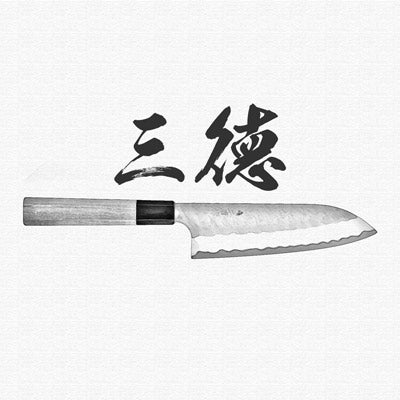
Profile: Santoku
Santoku
Slide for more >>
-

Handle Specs
Profile: Octagonal WA
Material:
<< Slide for more