Crows Nest store now open from Friday to Tuesday, in store specials!

Mazaki  |  SKU: MAZA_B2MK_DE180

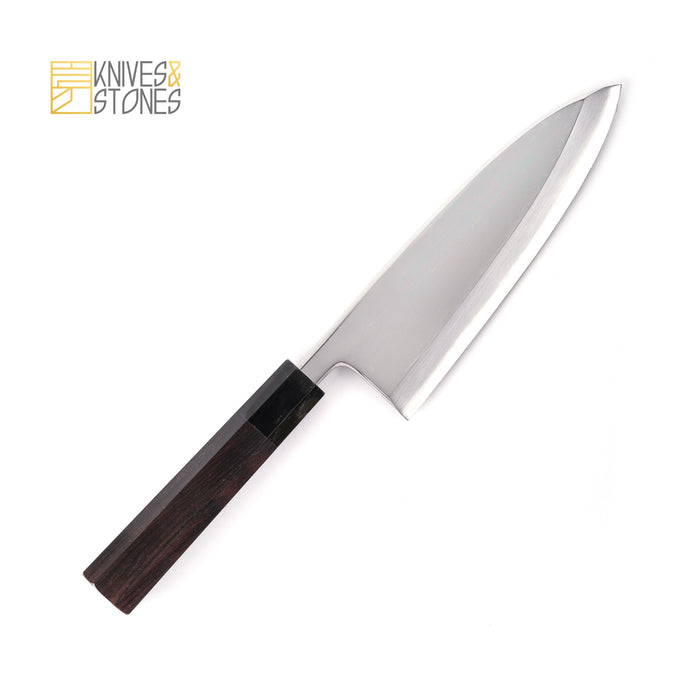
Mazaki Blue 2 Migaki Deba 180mm

Regular price $11,824.00
Tax included Shipping calculated at checkout.

Detailed Specifications
Line To Be Added - Non Stainless Clad
Profile Deba
Bevel Type Double Bevel
Weight 264 g        9.31 oz
Edge Length 188 mm   .7.4 inch
Heel Height 56 mm     .2.2 inch
Width @ Spine 7.2 mm     0.28 inch
Width @ Mid 4.6 mm     0.18 inch
Width @ 1cm from Tip 2.1 mm     0.08 inch
Steel Blue 2 / Aogami #2 | Carbon
Blade Construction To Be Added
Hardness (HRC) 61 - 63
Surface Finish To Be Added
Handle Ho Wood Octagonal
Best for
  • To Be Added
    • Free shipping for knives over AU$200 Australia wide.
    • World-wide shipping via DHL Express, 3 to 5 days.

    The Mazaki Blue #2 Migaki Deba 180mm is a traditional Japanese fish-processing knife that exemplifies handcrafted performance from Sanjo, Niigata. Built around a Blue #2 carbon steel core, the blade takes and holds a keen edge, offering strong cutting performance while still being relatively straightforward to sharpen with good technique.

    Deba knives like this are designed primarily for breaking down whole fish — from filleting and collar work to cutting through fins and joints — thanks to their stout, heavy profile and robust spine. The migaki finish enhances the blade’s smoothness and helps food release during cuts, while the carbon steel cladding gives a traditional aesthetic and encourages patina over time.

    Characteristic of Mazaki’s work, this 180 mm deba often features careful distal tapering and finely finished geometry that supports both power and control at the edge, making it a rewarding tool for cooks who appreciate refined, manual sharpening and traditional knife feel.


    Care Instruction
    1. Don't cut hard things! Japanese knives are brittle so bone hacking is a NO NO!
    2. Wash with neutral detergent after use, and wipe dry;
    3. Please don't wash knife with dishwasher, it will damage the wood handle;
    4. Be careful not to leave the knife close to a heat source for a long time;
    5. It is a lot more dangerous to cut with a blunt knife than a sharp knife!
    6. It is best to sharpen a Japanese knife regularly on a waterstone.
    7. Oil the (carbon) knife if storing for an extended period of time to prevent rust.
    • Profile: Deba

      A deba knife is a traditional Japanese kitchen knife specifically designed for butchering fish, though it can also be used for poultry and other meats with smaller bones. Here are some key characteristics and features of a deba knife:

      Blade Material: Deba knives are available in various materials, including traditional carbon steels such as shirogami (white steel) and blue steel, as well as stainless steel variants like molybdenum stainless steel. Carbon steel is preferred for its excellent sharpness and edge retention, while stainless steel variants are less prone to rust.

      Blade Design: Deba knives typically have a single bevel blade, meaning they are sharpened completely on one side. This design is intended for right-handed use, though left-handed versions are available by special order.

      Blade Geometry: The blade of a deba knife is heavy and thick-spined, with a blade length ranging from 5 to 7 inches. This design, along with the weight of the knife, allows it to easily cut through fish bones and joints.

      Primary Purpose: The primary purpose of a deba knife is to break apart full fish, removing heads, fins, and bones, and filleting them. It is also suitable for butchering poultry and other meats with smaller bones.

      Technique Tips: When using a deba knife, it's recommended to allow the weight of the blade to do the work. A sturdy grip is essential, with the middle, ring, and pinkie fingers wrapped firmly around the handle. The pointer finger should be placed on the spine of the knife, while the thumb is positioned close to the heel edge of the blade to steady the strokes. When cutting through bones, downward pressure should be applied with the non-dominant hand to push the knife cleanly through.

      Slide for more >>

    • Steel: Blue 2 / Aogami #2

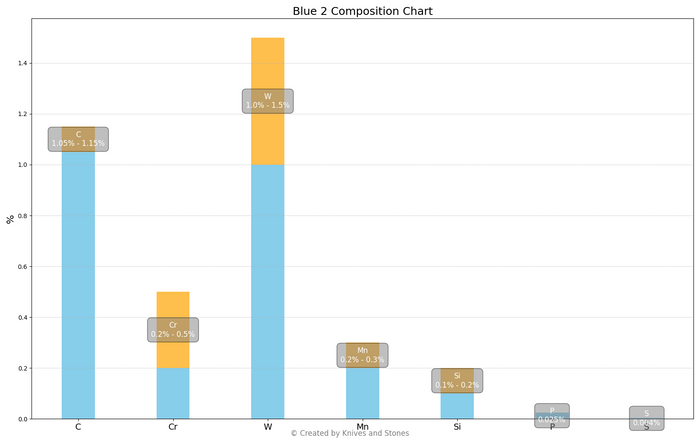
      Blue Steel No.2, also recognized as Aogami No.2, is a distinguished high carbon steel produced by Hitachi Metals Ltd, enhanced by the addition of chromium and tungsten to the base of White Steel No.2. This modification brings about an improvement in toughness and the creation of hard carbide molecules, which significantly boost edge retention. Although its sharpness is comparable to that of White Steel No.2, Blue Steel No.2 offers a slight advantage in maintaining its edge.

      Widely favored for its versatility, Aogami No.2 is celebrated for its ease of sharpening and robust resistance to chipping, making it an ideal choice for those new to Aogami steel knives. Containing 1.0–1.2% carbon and achieving a typical hardness of 62–63 HRC on the Rockwell scale, it stands as the benchmark in evaluating Aogami steel cutlery.

      Manufacturer:

      • Hitachi Special Steel, Japan

      Nature: Carbon

      Hardness: 61- 63

      << Slide for more >>

    • Handle Specs

      Profile: Octagonal WA

      Material:

      • Ho Wood

      A ho wood octagonal handle is a traditional Japanese knife handle prized for its light weight, balance, and natural aesthetic. Crafted from ho wood (Japanese magnolia), the handle offers a smooth, comfortable grip that remains stable even during long periods of use. Its pale, subtly grained appearance complements the refined simplicity of Japanese blades.

      The octagonal shape provides excellent control and ergonomics, allowing both right- and left-handed users to maintain a secure, precise hold. Unlike heavier Western handles, ho wood handles shift the knife’s balance point closer to the blade, enhancing agility and cutting precision.

      Often paired with a water buffalo horn ferrule, the ho wood handle also resists humidity and minimizes cracking. Its understated elegance and functional design reflect the Japanese philosophy of harmony between tool and craftsman—making it a favored choice among professional chefs and knife enthusiasts who value tradition, comfort, and performance.

      << Slide for more